Running Cadence at Home: How Dino Survival Measures Every Step
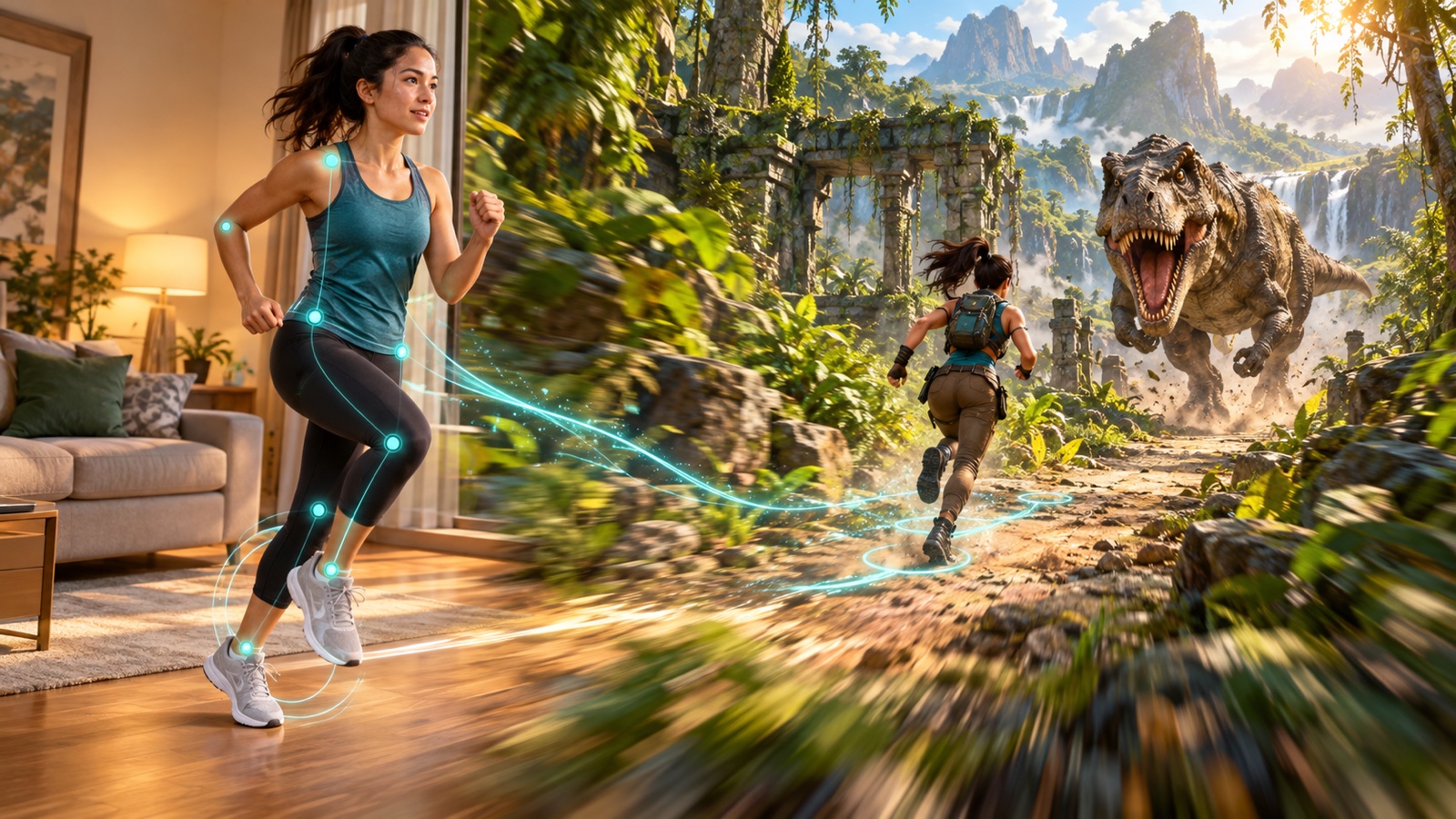
The most important number in Dino Survival is not the score. It is running cadence: how many valid steps the game sees per minute.
I use that number to decide whether the runner is walking, jogging, running or sprinting. It controls how quickly the trail moves, how fast the player reaches the jeep and whether the dinosaur gains or loses ground. If the player stops, the cadence returns to zero and the escape stops too.
That sounds simple, but a webcam never sends me a clean message saying, “this person just completed one step.” It sends a changing set of body landmarks. I have to turn those points into a reliable rhythm while rejecting arm waving, camera noise and half-visible legs.
What running cadence means inside the game
Running cadence is usually expressed as steps per minute. Dino Survival calculates it from the valid steps detected during a rolling three-second window. If the window contains seven steps, for example, that becomes an estimated 140 steps per minute.
The short window is a compromise. A longer average would look smoother, but it would keep rewarding an old pace after the player slowed down. A very short average would jump every time one pose frame arrived late. Three seconds gives the chase a stable number that can still respond to a real change in effort.
This is a game-control estimate, not the same thing as a calibrated watch, foot pod or laboratory measurement. Its purpose is to make the game respond consistently to running in place.
How the webcam sees running at home
The pose model returns landmarks for the body. For cadence, I focus on the shoulders, hips, knees and ankles. The shoulders and hips define the direction of the torso. The knees and ankles tell me how each leg is moving relative to that body axis.
Measuring movement relative to the player matters at home. A laptop camera may sit below eye level. A phone may be tilted. One player may stand close while another is farther away. I first calibrate a local range from the player’s own proportions instead of assuming that every knee must cross one fixed line on the screen.
The game also checks that both hips and both knees remain visible. If the necessary landmarks disappear, it asks the player to step back rather than inventing a cadence from incomplete information.
How a knee lift becomes one valid step
For each leg, the detector combines knee and ankle lift and smooths that signal. It then watches for a rise, a peak and a clear fall. That complete pattern is important. A knee that jitters near the top should not become several steps.
The minimum lift is adaptive because bodies, clothing, camera positions and running styles differ. The gate begins with a fixed floor and learns from recent movement, while a hard ceiling prevents one very high knee lift from making the next normal step impossible to detect.
After one leg produces a valid peak, that same leg enters a 130 millisecond refractory period. This is a short no-repeat window. It stops pose jitter around one lift from becoming two or three imaginary steps.
How Dino Survival rejects false cadence
Alternating knee movement is necessary, but it is not enough. The detector also keeps a short history of the hips and looks for real vertical body movement. A step only counts when the leg pattern and the larger movement signal agree.
This is why waving both arms cannot create a sprint. It also helps reject small landmark tremors when the player is standing still. The rule does not try to judge running form. It only asks for evidence that the lower body is actually doing the work.
If no valid step arrives for about 1.1 seconds, cadence snaps to idle. I made that reset decisive because a home exercise game should stop giving credit when the player stops moving.
How steps per minute become game pace
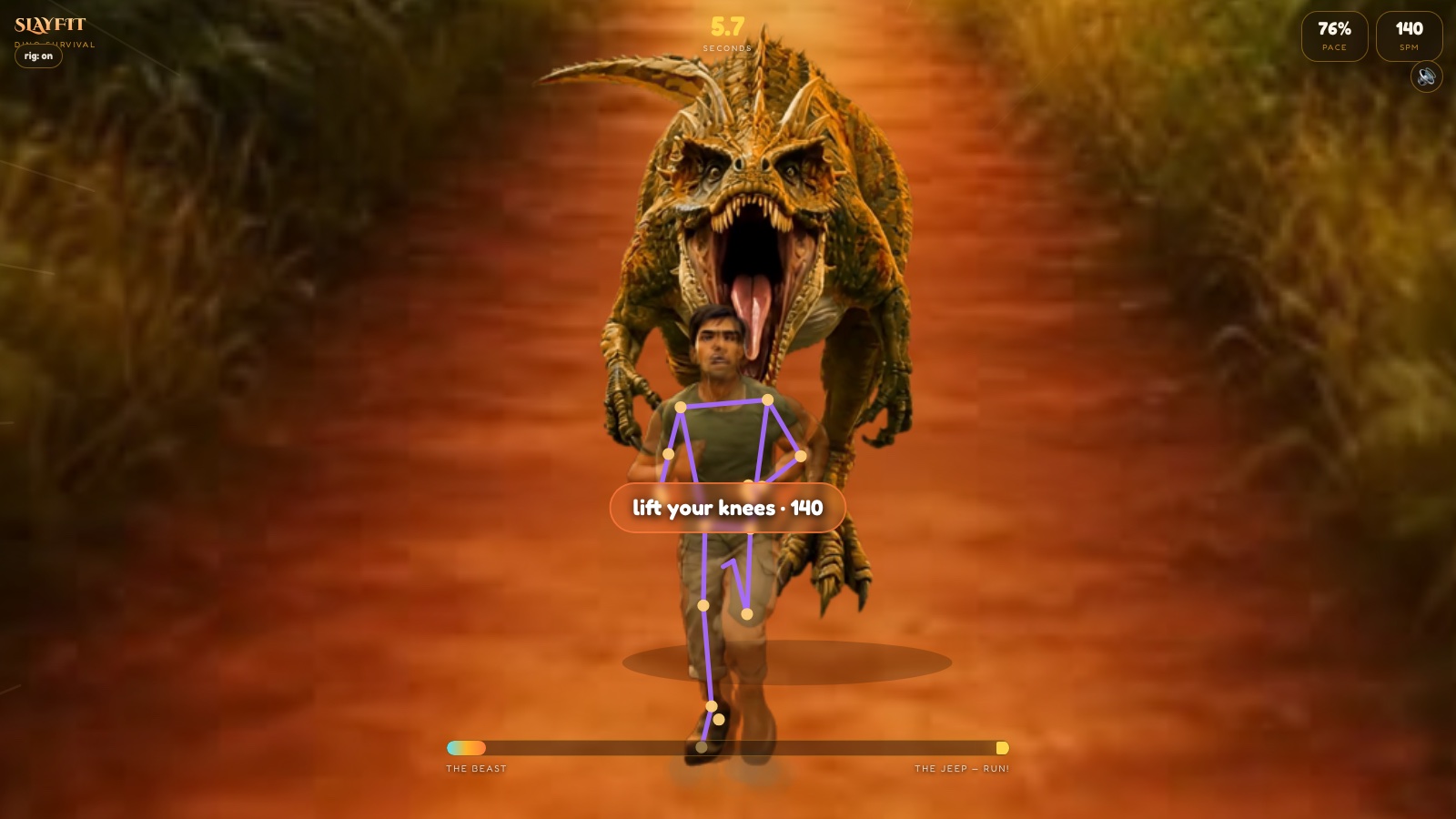
The detector groups the estimate into understandable bands. Around 70 steps per minute reads as jogging, 120 as running and 160 as sprinting. The continuous cadence value also becomes a pace between zero and one.
That pace moves the runner towards a 50-unit escape goal. At the same time, the dinosaur has its own speed and gets faster as the run continues. If the player’s pace is higher, the safety gap grows. If the dinosaur is faster, the gap shrinks.
The important part is that cadence does not fill a separate exercise meter. It changes the situation the player already cares about.
The trail moves only when the player moves
The jungle background is a sequence of 40 images, but it is indexed by accumulated distance rather than ordinary clock time. Running advances the sequence. Standing still freezes it. The runner animation and kicked-up dust use the same pace signal.
That creates several layers of feedback from one input:
- Cadence: the display reports the current movement rhythm.
- Distance: the progress bar shows how much of the escape remains.
- World motion: the trail and speed effects respond to pace.
- Threat: the dinosaur grows larger as the gap closes.
- Sound: footsteps and the chase become more urgent with danger.
No single cue has to explain everything. Together, they answer the question a player keeps asking during the run: is this effort enough?
Why the dinosaur works better than a generic workout timer
A timer tells you how long you have been moving. A chase tells you what your current pace means.
Dino Survival starts with a lead of 0.30 on its normalised gap scale. The dinosaur begins with a speed value of 0.66, then adds 0.0065 every second. The player is not racing a fixed target. The required effort increases as the chase develops.
This creates a natural pacing problem. Starting too gently lets the dinosaur take away the safety margin. Finding a sustainable rhythm creates space. A late burst can rescue a close run, but only if enough distance remains. The player learns this relationship through the changing scene rather than through a paragraph of instructions.
The score rewards completing the movement, not farming points
Dino Survival does not award points for every detected step. The central result is whether the player escaped, followed by the completion time. That keeps the objective aligned with the story.
The game also records cadence and active time for the post-run summary. Those numbers are useful for comparing attempts, but they do not turn Dino Survival into a calibrated fitness test. Camera angle, framing, movement style and the pose model all affect the estimate.
I prefer that honest boundary. The game can show a player how the current run behaved without pretending to measure health, athletic ability or exact energy expenditure.
What research says about active video games
Researchers usually define active video games as games that require bodily movement to play. A 2023 systematic review and meta-analysis examined 25 longitudinal studies, with 19 included in the pooled analysis. It found a moderate positive effect on overall physical activity, but it also found substantial variation between studies. The platforms, populations, intervention lengths and measurements were not all the same. Read the systematic review of active video game interventions.
A 2025 umbrella review of 20 systematic reviews reached a similarly careful conclusion. Active games can promote physical activity during use, with stronger evidence in some populations, but long-term adherence, safety reporting and study consistency remain important gaps. Read the umbrella review of active video games and physical activity.
That evidence supports the category. It does not prove that every active game produces the same intensity or benefit. Game design matters, and Dino Survival itself has not been tested in a controlled physical-activity study.
What I can claim about Dino Survival
I can say that the game requires real lower-body movement in camera mode. I can explain how cadence affects progress, how stopping freezes the world and how the changing chase asks the player to adjust effort. I can also say that a keyboard demo exists for people who want to understand the experience without camera access.
I cannot claim that one run replaces a planned workout, meets a particular exercise prescription or produces a specific health outcome. Public-health recommendations depend on frequency, intensity, duration and the person doing the activity. The World Health Organization physical activity guidelines are a better source for those questions.
The useful role of a game is smaller and more immediate. It can give movement a reason, give effort visible consequences and make a short active break easier to start.
Why running in place is useful exercise at home
Running in place removes several barriers between deciding to move and actually starting. It needs no treadmill, route or separate controller. Dino Survival uses a browser and a webcam, so there is no download and no sensor to pair.
The game asks for enough clear floor space to move safely and a camera view that includes the hips and knees. It then gives a three-second countdown and starts the chase. For someone looking for a short running in place exercise or an at home running workout, that makes the first step unusually simple.
The dinosaur also gives the movement a reason. Instead of watching a timer, the player sees effort create distance and slowing down create danger. That does not make the game a replacement for a planned fitness programme. It makes a short active session easier to understand and more engaging to repeat.
Accessibility is not the same as suitability for everyone. Players should use a clear, stable area, stop if they feel unwell and choose activity appropriate for them. The dinosaur is fictional. The need to move safely is not.
Why I think this is the right kind of active game
The strongest part of Dino Survival is not that it counts movement. It is that the movement changes one understandable relationship: the distance between the runner and the dinosaur.
Every supporting system reinforces that relationship. Cadence changes pace. Pace changes distance. Distance moves the trail. The gap changes the dinosaur’s scale and urgency. The final time gives the next run a target.
That is what I want from active video games. The exercise should not sit beside the game. It should be the action that makes the game possible.
Run from the dinosaur
Play Dino Survival free in your browser. Use camera mode to control the chase by running in place, or use the keyboard demo to learn the rules first.
Free to play · No download · Webcam or demo mode · Running cadence controls the escape.
If you want the technical story, read how I built the running detector and survival engine. You can also explore more SlayFit movement games.