Endless Runner Games: Why Dino Survival Ends at a Jeep
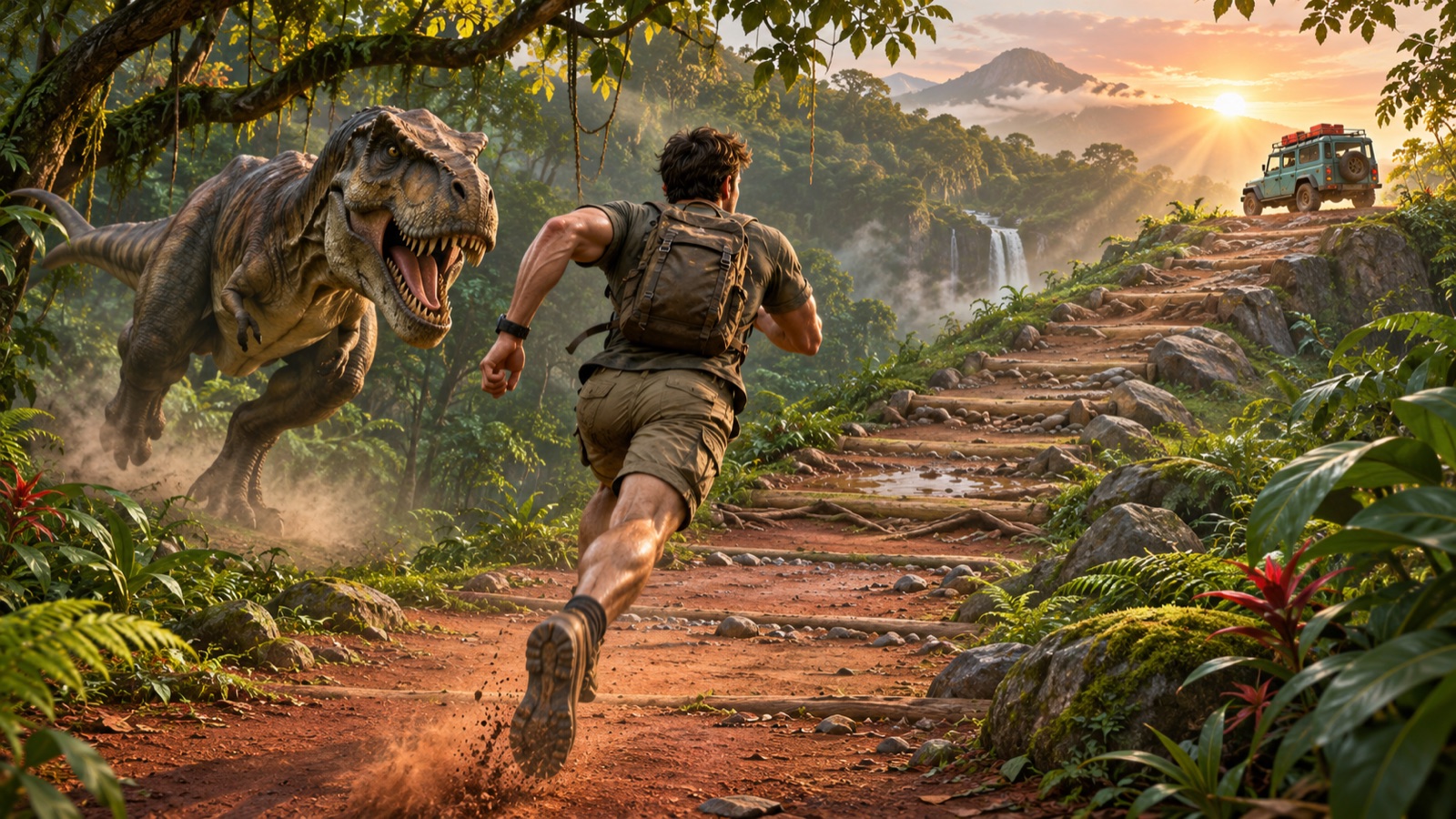
I wanted to make a running game where stopping had an obvious consequence. The dinosaur gets closer. Keep moving and the jeep gets closer instead.
My first design looked like many endless runner games: survive as long as possible and watch one number climb. It worked, but it gave the player no destination. A slow run and a strong run both ended the same way, only at different times.
I replaced the endless trail with ten finite races. Every level has a jeep, a distance and a chase that can actually end. That decision changed how I tuned the pace, progression, score and final few seconds.
An endless score was not enough
An endless format has a clean loop. The game keeps adding speed until the player fails. The score tells them how long they lasted.
Dino Survival uses the player's own cadence as its main control. That made me want a more concrete bargain. If someone keeps a readable rhythm for a short race, they should be allowed to escape. Failure should mean the dinosaur caught them before the finish, not that the design eventually made survival impossible.
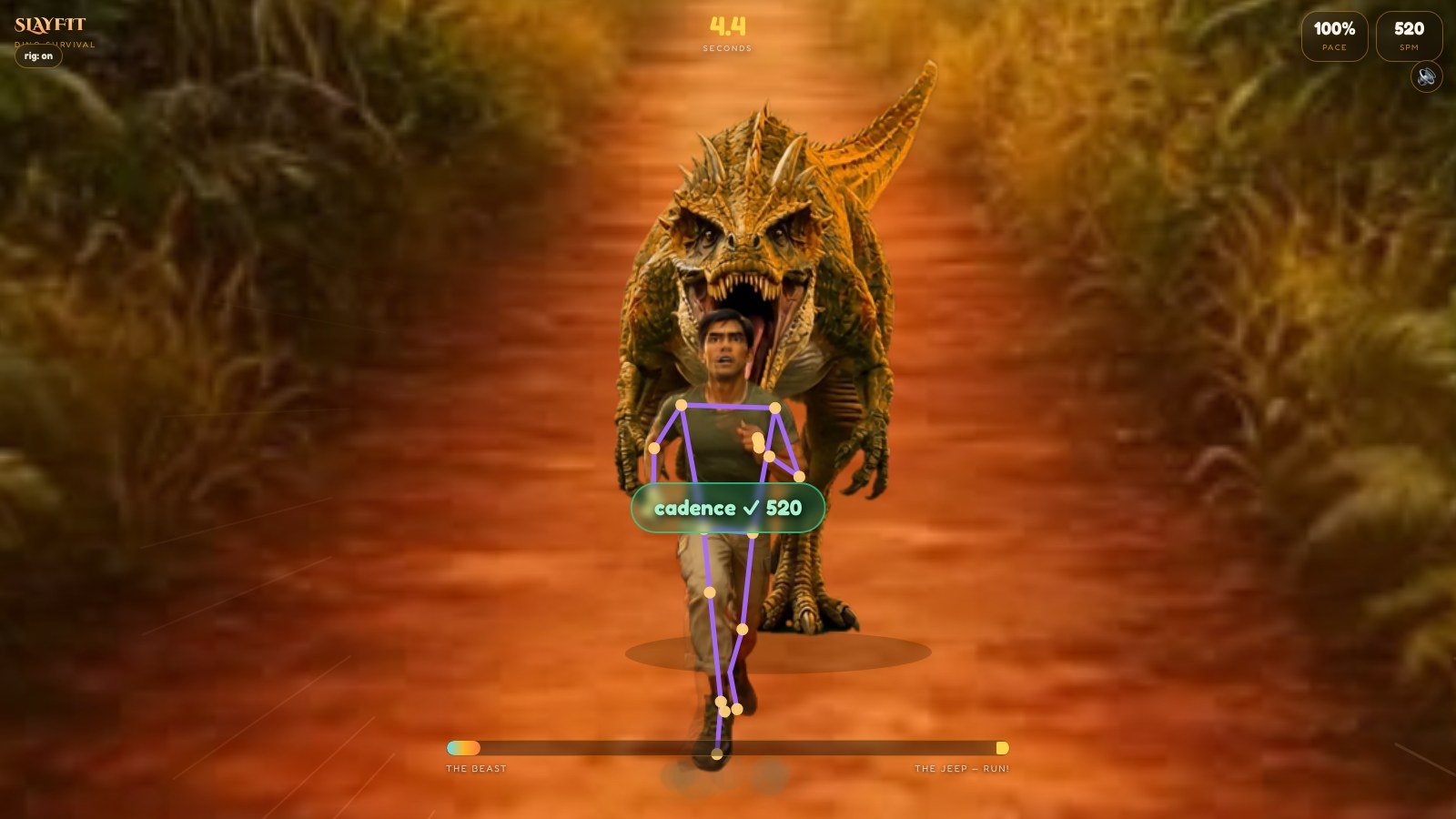
The jeep gave me that finish. The progress bar runs from beast to jeep. The world moves only when pace is detected. The player always knows which side of the bargain they are keeping.
Level one lasts about ten seconds on purpose
The first race uses a reference time of ten seconds at the game's steady run pace. I wanted the player to learn the entire loop before fatigue or uncertainty became the main problem.
Ten seconds is enough to see the countdown, establish cadence, move the trail, watch the distance bar fill and reach the escape cutscene. It is also short enough to retry after a framing mistake.
This is not an exercise recommendation. The reference time is a level-design value. It tells the engine how far away to place the jeep for the expected game pace.
The ladder grows by twenty seconds at a time
Each new level adds twenty seconds to the reference race. The sequence is 10, 30, 50 and 70 seconds, continuing until level ten reaches 190 seconds.
I preferred a regular ladder because the player can understand the change. A new level is not a mystery difficulty label. It is a longer distance with more time for rhythm to drift and for the dinosaur's pressure to build.
Longer does not mean the same chase copied ten times. The dinosaur's starting speed rises across the ladder. Its target ending speed rises too. At the same time, the player's starting lead falls from 0.55 on level one toward 0.30 on the later races.
Distance and danger are separate systems
The survival engine tracks two related values. Distance measures progress toward the jeep. Gap measures how much safety remains between the runner and the dinosaur.
Pace increases distance every frame. The same pace is compared with the dinosaur's current speed to change the gap. A player can therefore be moving toward the jeep while still losing safety if the current rhythm is too slow.
This separation made the chase more readable. Distance answers, “How close am I to finishing?” Gap answers, “Am I fast enough right now?” One value creates hope. The other creates pressure.
The dinosaur ramps inside each race
The dinosaur does not run at one fixed speed. Its speed increases with elapsed time. Early in a race, the player has space to find a rhythm. Later, that same pace may no longer be enough.
I like that curve because it creates a final act. The last stretch asks for consistency or a deliberate surge. It also makes a longer level more than a bigger distance number.
The actual engine stays small. It advances elapsed time, distance, gap and scroll position. Escape happens when distance reaches the goal. A catch happens when the gap reaches zero. The camera and renderer do not own those rules.
A finite race makes the result useful
When a player escapes, the result is a time for that specific level. Faster is better. Each level has its own leaderboard because a ten-second opening race and a 190-second final race are different problems.
If the player is caught, the result shows how much of the route they completed and how long they survived. That gives the next attempt a concrete target. Reaching 82 percent is more informative than simply losing.
The escape and catch cutscenes also have a job. The jeep is not only a marker on the progress bar. Reaching it produces a real getaway. Getting caught produces a clear end to the run. Both outcomes close the race before the result screen appears.
Progression stays on the player's device
Level one starts open. Escaping level one unlocks level two, and so on. The highest unlocked level is stored locally and clamped between one and ten when the game reads it.
This keeps the level ladder simple. A returning player can resume at the frontier they already reached. They can also replay an earlier open level and chase a better time.
The unlock is separate from the leaderboard. Local progression does not depend on a score request succeeding. If the network is unavailable, the next race can still open after a valid escape.
Why I still call it an endless-runner idea
The feel still comes from running games built around continuous forward motion. The trail scrolls, danger follows from behind and the player's task is to maintain movement. Dino Survival simply gives that loop chapters and an ending.
That made more sense for a webcam-controlled dinosaur running game. The player is moving in a real room, not holding one button. A visible finish lets them choose a short first race, understand the demand and decide whether to continue.
The finite structure also made tuning easier. I can ask whether level four is a fair 70-second chase, rather than trying to balance one curve that must feel good forever.
What the jeep taught me about level design
- A visible destination can explain a game faster than a score label.
- A short first level should demonstrate the whole loop.
- Regular increases make progression easier to understand.
- Distance and danger can create different kinds of feedback.
- A rising threat gives each finite race a final act.
- Per-level times are more useful than comparing unlike races.
- Local unlocks should survive a failed network request.
Run the first race
Play Dino Survival in your browser. Use the camera to run in place, or choose demo controls. Reach the first jeep, then see how the same chase changes across the ten-level ladder.
For practical help, read my seven ways to reach the jeep. For the controller details, see how Dino Survival measures running cadence.