Physics Puzzle Games: How I Built Yantra's 70 Broken Machines
I wanted to build a puzzle where pressing Start was more interesting than placing the answer.
The first version of Yantra had the basic loop. A hopper released steel balls. A few loose ramps sat in the wrong places. The player repaired the route, pressed Start and watched whether the balls reached the machine.
That small test became 70 levels across five worlds. The hard part was not adding more pieces. It was making every new machine ask a different question while keeping the result readable. Good physics puzzle games let the player see why an idea worked, why it failed and what to change next.
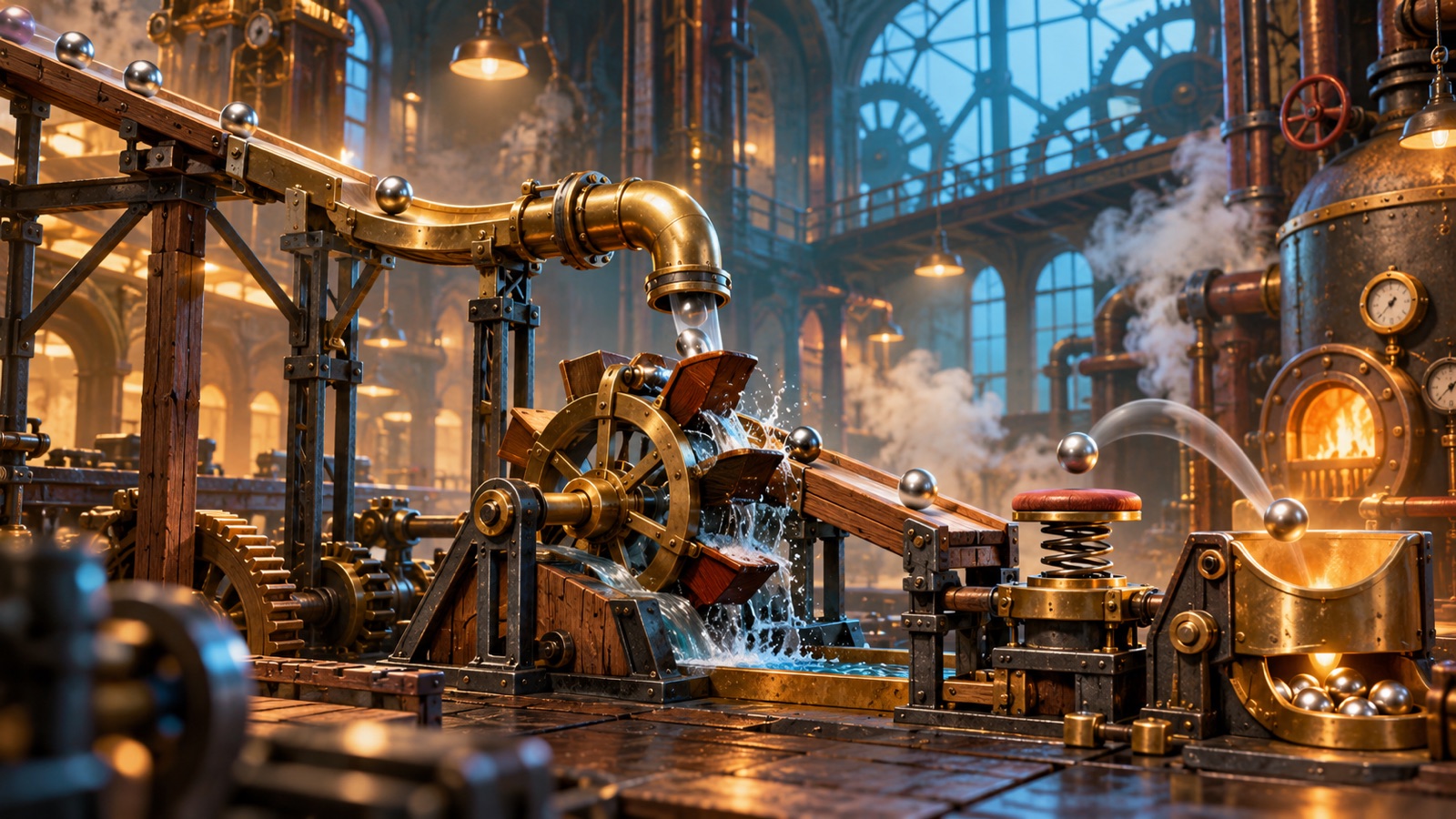
I started with a broken machine, not an empty board
An empty construction space can be intimidating. It asks the player to invent the whole system before they understand its rules.
Yantra begins differently. Most of the machine is already present. One or more parts are loose or misplaced. The hopper and receiving machine make the direction clear. The player is repairing something that almost works.
Level 1 has two slate ramps and only one part is off. The tip says exactly what to do: drag the loose piece into place, then press Start. I do not explain velocity, collision normals or gravity. The moving ball explains them.
This became the teaching pattern for the whole contraption game. Show a nearly complete path. Break the part that carries the new idea. Let the simulation deliver the explanation.
The Start button separates thinking from evidence
While the machine is stopped, the player can drag and rotate parts. Nothing needs to be placed on an invisible grid. The important question is whether the surfaces form a believable route.
Pressing Start changes the activity. Planning becomes observation. The steel balls fall under gravity, collide with the placed parts and either reach the goal or spill out of the machine.
I kept those two states separate because the pause matters. It gives the player a moment to make a prediction. When the result appears, there is something concrete to compare with that prediction.
A miss is not just a red failure screen. The ball might leave the end of a ramp too quickly, strike the wrong face of a one-way flap or lose momentum before a climb. The route itself shows where the idea stopped working.
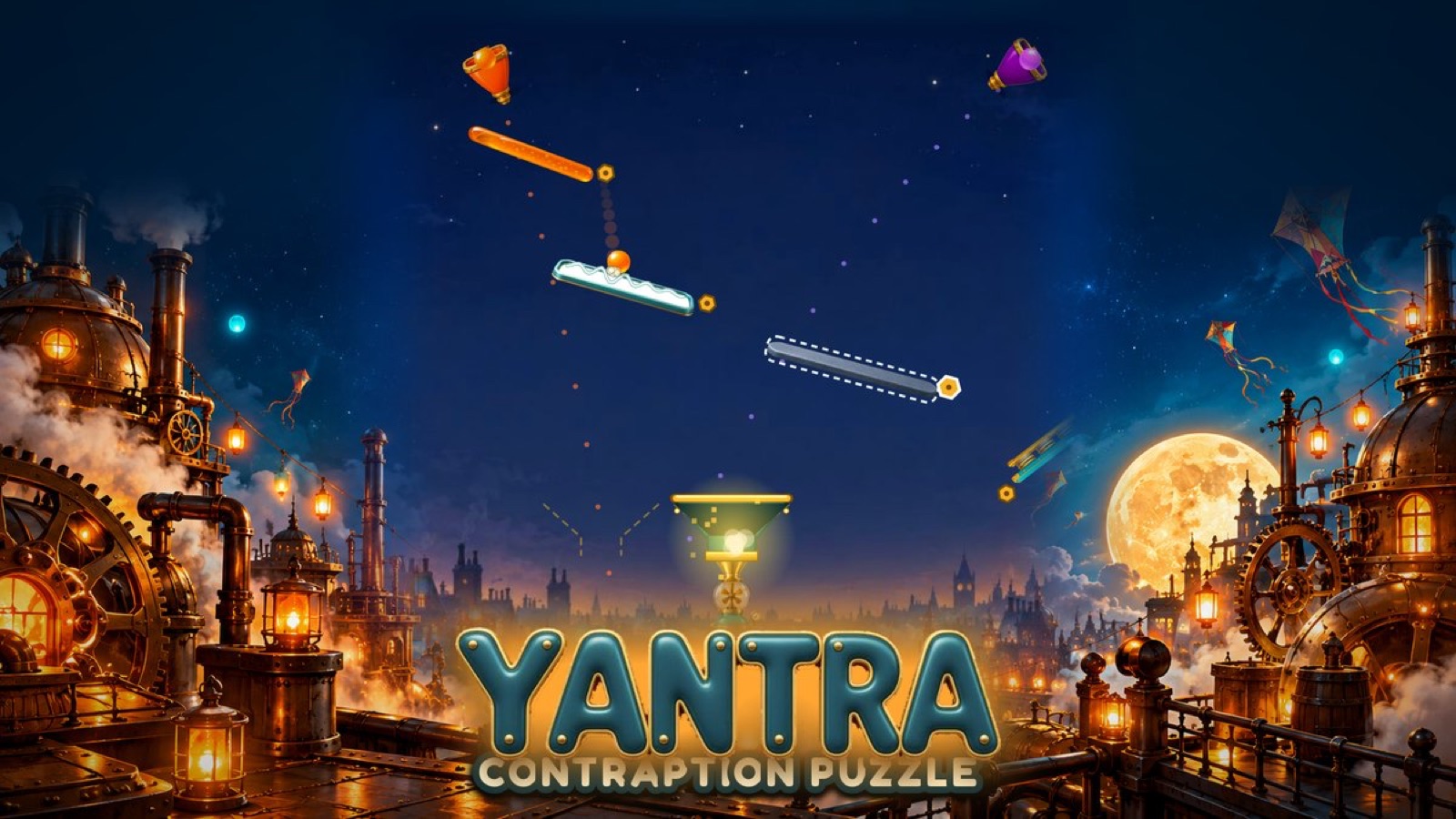
Eight materials create eight kinds of reasoning
I did not want later levels to be wider copies of the opening ramp puzzle. Yantra introduces parts in fixed stages so each one changes how the player reads a ball path.
- Slate creates the basic ramp. Its angle controls direction and speed.
- Amber adds another hard surface and a new visual language for mixed routes.
- Silk catches a moving ball briefly, sags under its weight and changes the release.
- Oobleck creates a softer, thicker surface with a different response.
- Gust fans carry balls through a directional zone instead of relying on contact alone.
- Spring pads turn downward speed into a controlled launch.
- Paddle wheels rotate only when a ball pushes them, so timing and momentum affect the next movement.
- One-way flaps bounce a ball from the front and let it pass through from the back.
The order is important. A spring makes sense after the player understands ordinary bounce. A one-way flap becomes interesting only after both sides of a part already feel meaningful.
Five worlds give the same rules a new purpose
The 70 numbered levels are divided evenly across five worlds: the Boiler Room, Water Mill, Dynamo Hall, Clock Tower and Coke Ovens. Each world has 14 levels and its own receiving machine.
The goal still catches balls, but the animation changes the meaning of delivery. In the Boiler Room, balls drive a steam piston. In the Water Mill, they send water over a wheel. In the Dynamo Hall, they brighten a bulb. The Clock Tower advances an escapement. The Coke Ovens fill a charging car that moves along rails.
At the end of every world, a hand-made finale places the familiar parts inside a larger industrial scene. The player repairs a coal feed, a paper mill or another real machine rather than completing a more decorative version of the standard board.
I added those finales because a long campaign needs punctuation. Fourteen small repairs build fluency. The finale then asks the player to use that fluency inside a machine that looks and behaves like an event.
Spills make a working answer different from a clean answer
A level can be solved without being solved perfectly. Delivering the quota clears the machine and earns one star. A careful run can earn two. A run with no spills can earn three.
This scoring rule leaves room for rough but valid solutions. The first success answers, “Can this route work?” Replaying for three stars asks, “Can it work reliably?”
I prefer that progression to requiring one exact placement. Two players can build slightly different routes and still clear the same machine. The physics decides whether each route survives repeated balls.
Stars also open later worlds. This gives the player a reason to revisit an imperfect machine without forcing every early level to be perfect before the next one appears.
Hints point to a part without playing the level
A physics puzzle can fail because the concept is wrong or because one rotation is slightly off. Those are different problems, but they can look identical after the ball spills.
Yantra's hint system highlights a useful placement instead of running the whole solution. The player still has to move the part and understand how it connects to the surrounding path.
The first hints are available immediately. Later, delivered balls also become a currency for Vishwa's cabinet. The cabinet sells single-use versions of familiar parts and extra hints. These bought parts are optional helpers. They never replace the level's own solution pieces, and they do not count against the normal part target used for stars.
A daily puzzle keeps the system from becoming a memorised route
The numbered campaign is authored and repeatable. That is useful for pacing, but eventually a returning player can remember where a part belongs.
The Daily mode builds another machine from a seed. It uses the same physics and part vocabulary, but asks the player to read a fresh arrangement. A won daily also awards a cabinet part.
This is where the system earns its keep. Once ramps, fans, springs and flaps behave consistently, they can be recombined without writing a new rule for every board.
What I learned from building 70 machines
- Start with a machine that almost works, so the player can focus on one missing idea.
- Let motion explain the rules whenever the result can be seen clearly.
- Introduce one new part before combining it with the full toolbox.
- Keep a basic clear separate from an efficient, spill-free solution.
- Use finales to change the scale and meaning of a familiar system.
- Make optional help useful without letting it erase the puzzle.
Fix the first machine yourself
Yantra works because the question stays simple even when the machines become complicated. Where should this part go so the next ball reaches the goal?
Play Yantra: Contraption Puzzle free in your browser. Start with the first broken ramp, press Start and watch the path before changing anything else.
Free to play · No download · Mouse or touch · 70 levels · Five world finales · Daily puzzles.
If you enjoy building and testing, read seven practical ways to build stronger bridges in Puliya. You can also browse more free browser games that need no camera.