Engineering Games and Cognitive Skills: How Puliya Makes You Think
When I started designing Puliya, I did not want ten levels that were simply longer versions of the same bridge. I wanted every level to change the question in the player’s head.
The first question is basic: how do I connect two fixed points? Later questions are different. Why does a square fold? Where should I place support? Can the same bridge carry two cars? What happens when the road climbs? Which design survives a heavy truck without wasting the budget?
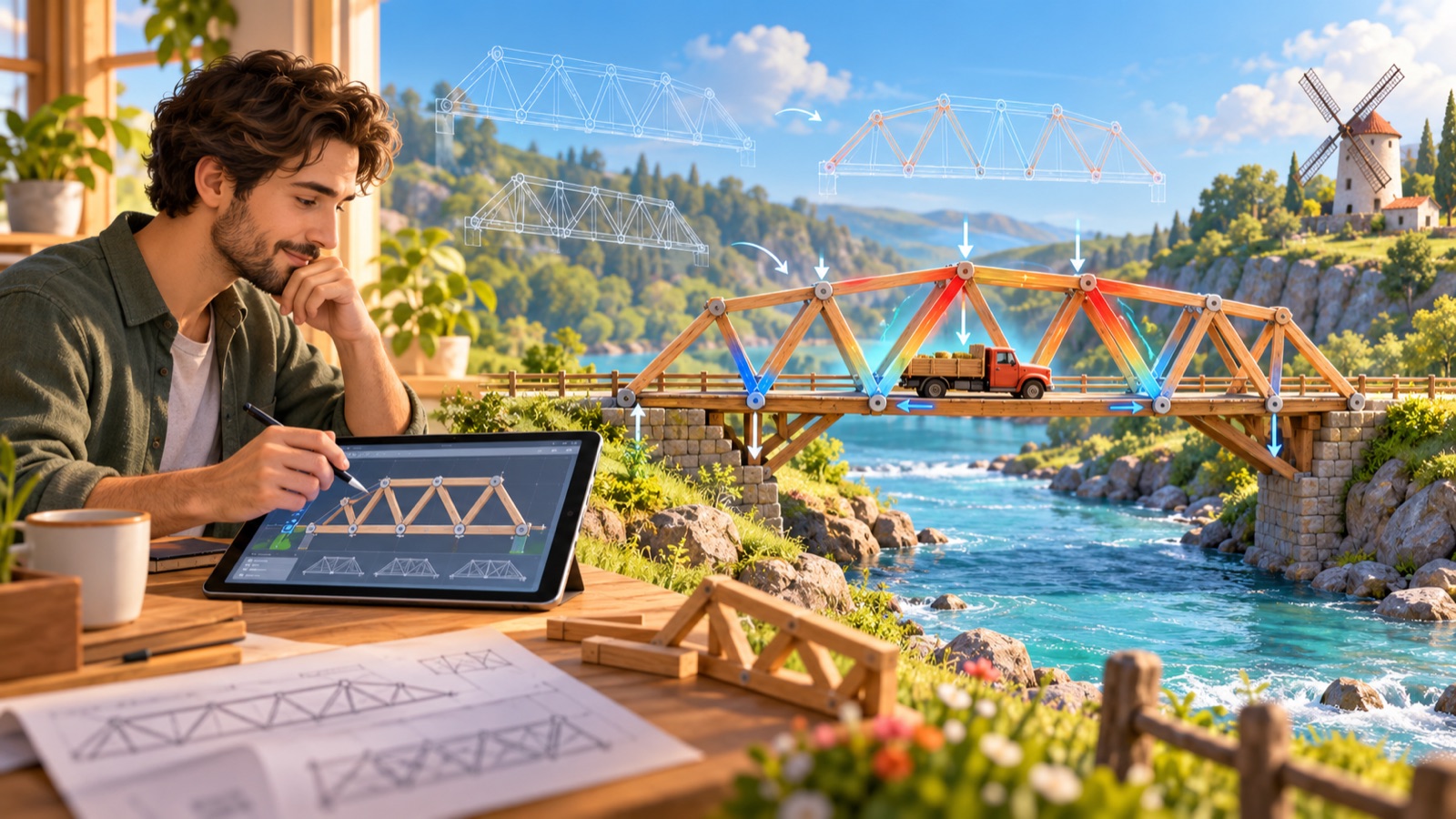
This is what makes engineering games interesting to me. The player is not recalling a fact and selecting an answer. They are building a model, testing it, observing the failure and changing the model. Puliya turns that loop into a cosy bridge building game with real-time physics.
First, a careful claim about games and intelligence
It is tempting to say that a puzzle game makes people smarter. The research does not support a claim that broad.
Studies of video-game training have produced mixed results. One large meta-analysis found no convincing causal evidence that video-game practice improves general cognitive ability. A later meta-analysis reported a small overall training effect, but also found publication bias and stressed that specific game features matter more than broad genre labels. The honest position sits between marketing slogans and total dismissal. Read the meta-analysis questioning broad cognitive transfer and the later game-factors meta-analysis.
Puliya has not been tested as a cognitive intervention, so I do not claim that it raises IQ or transfers automatically to school, work or real engineering. What I can show is which cognitive processes the game requires while you play: spatial reasoning, causal prediction, planning under constraints, monitoring feedback, revising a strategy and combining earlier rules in a new situation.
Why a bridge builder creates a useful thinking loop
Every Puliya level begins with an incomplete structure and a clear outcome. The vehicle must reach the other bank. The player chooses where to place road and wood, spends from a limited budget, then presses Test.
The simulation makes the consequences visible. Members bend. Stress colours move from green to orange and red. A long piece may buckle. A weak joint may fail. A road may be structurally sound but too steep for the vehicle. The player can stop, keep the bridge and change only the part that caused the failure.
Research using physics puzzle games describes a similar process as structured trial and error. In the Virtual Tools experiments, people used a cycle of sampling a solution, mentally or physically simulating its result, and updating the next attempt. The researchers argue that flexible physical problem solving depends on an internal model of how the world works, not blind repetition. See the study of trial-and-error learning and physical reasoning.
That is the loop I wanted in Puliya. Failure gives information. The useful question is not “Did I lose?” It is “Which assumption was wrong?”
How the ten levels cover different kinds of thinking
The levels in Sunny River are arranged as a learning sequence. Each one isolates an idea before later levels ask the player to combine several ideas at once.
Level 1, First Plank: learning the system
The first level has two anchors, one road tool and one small gap. It exercises rule discovery and basic means-end planning. The player learns that vehicles travel on road pieces, anchors do not move and construction begins from valid connection points.
This level is deliberately narrow. A new player should spend attention on the interaction itself, not on choosing between several structural ideas.
Level 2, Saggy Stream: causal reasoning
The span becomes longer and wood becomes available. A road can reach the other side but cannot support the van by itself. The player has to connect an observed effect, the sagging deck, to a structural cause, missing support.
This is the first real hypothesis test: “If I add beams beneath the road, will the load move through them into the anchors?”
Level 3, Wobbly Square: changing a mental model
The level begins with a nearly complete bridge made from rectangles. It looks orderly, but squares can shear and fold. One diagonal turns a flexible rectangle into triangles.
The cognitive task is not construction from nothing. It is diagnosis. The player must reject the visual intuition that a neat square is automatically stable and update the design with the new rule that triangles keep their shape.
Level 4, Triangle Town: spatial transformation
Now the player has to create a truss across a larger empty span. If there is no useful space below the road, support can go above it.
This level asks for mental transformation. The player takes a structural pattern learned in one orientation and rotates or reflects it into another. The principle stays the same even though the picture changes.
Level 5, Rock in the River: spotting an affordance
A rock in the middle of the water changes the problem. It is not decoration. It provides new anchor points and turns one long span into two shorter spans.
The thinking skill here is recognizing an affordance, meaning a feature of the environment that can be used as part of the solution. Good problem solving often begins by noticing that the constraints have also supplied a resource.
Level 6, Short Is Strong: decomposition
Long wooden members buckle. The answer is to divide them into shorter pieces and add intermediate joints.
This is decomposition in a very concrete form. A difficult large problem becomes a set of smaller, stronger units. The level also challenges the instinct that fewer pieces must always be better. Efficiency depends on what those pieces are being asked to do.
Level 7, Two Cars: reasoning about combined load
A bridge that carries one car may fail when two arrive together. The geometry has not changed, but the load case has.
The player must reason about accumulation and safety margin. Passing one test does not prove that a design is robust under a different condition. This shifts attention from “Does it work?” to “Under what conditions does it work?”
Level 8, Hill Road: balancing competing constraints
The two banks are at different heights. A strong bridge can still fail as a route if the road is too steep for the van.
This introduces multi-constraint thinking. Structural strength, road continuity, slope and budget all matter at the same time. Improving one part of a system can make another part worse, so the player must search for a balanced solution rather than maximizing a single variable.
Level 9, Over or Under: comparing strategies
The player now has enough knowledge to choose between different structural approaches. A truss can sit above the road, below it or use the available rock as a partial support.
The level is about strategy selection. Several designs may work, but they differ in cost, length, clearance and stress. The budget creates a reason to compare them instead of stopping at the first successful bridge.
Level 10, The Mill Bridge: integrating the full model
The final Sunny River level uses the longest span, a useful rock and the heavy farm truck. There is no single new trick. The challenge is coordination.
The player has to retrieve earlier ideas and combine them: stable triangles, short members, well-placed supports, a gentle road, an allowance for heavier load and a budget-conscious layout. This is closer to open problem solving because the level does not announce which rule matters most.
Why the order of the levels matters
Difficulty is not only about making a gap wider or a truck heavier. It is about controlling how many unfamiliar decisions arrive at once.
Research on Physics Playground, an educational physics game, found that the timing of instructional support changed how learners approached problems. Early support could help players identify a useful principle, but too much guidance could also narrow exploration. The study highlights a useful design tension: give enough information to make failure interpretable, but leave enough space for the player to generate the solution. Read the study on learning support and problem-solving behaviour in a physics game.
Puliya handles this by giving each level a short idea and an optional hint. “Triangles keep their shape” explains the principle. It does not draw the bridge. The player still has to decide where the triangles belong.
The budget changes success into optimisation
A bridge that survives earns the first star. Staying within budget adds another goal. The final star asks for a more efficient solution.
This matters because a binary pass or fail can end the thinking too early. Once the bridge works, the budget asks a second question: can the same outcome be achieved with a cleaner use of material? The player may remove a redundant beam, shorten a member or replace a brute-force structure with a better load path.
That is planning under constraint. It requires comparing alternatives, tracking cost and resisting the easy answer of adding support everywhere.
Stress view turns invisible physics into feedback
Forces are difficult to learn from when they stay invisible. Puliya’s stress view gives every member a consistent colour. Green is comfortable, orange is working hard and red is close to breaking.
The colours do not solve the puzzle. They make the result legible. A player can connect the location of stress to the geometry they built and decide where the next change should go. This supports metacognitive monitoring, which simply means checking whether the current strategy is working and deciding what to change.
What Puliya exercises while you play
- Spatial reasoning: imagining how roads, beams, anchors and triangles fit together.
- Causal reasoning: linking a collapse or buckle to the structure that produced it.
- Planning: choosing a layout before spending the full budget.
- Constraint management: balancing strength, slope, span, load and cost.
- Cognitive flexibility: abandoning a design that looks right but fails.
- Metacognitive monitoring: using stress and motion feedback to identify the weak point.
- Knowledge integration: combining earlier principles when later levels stop presenting one idea at a time.
These are processes the player performs inside the game. Whether practice transfers broadly beyond the game is a separate scientific question, and the evidence on broad transfer remains contested. That distinction does not make the thinking inside the game less real. It makes the claim more precise.
Why this is the right sort of problem-solving game
The best problem solving games make the player’s reasoning visible in the result. Puliya does that well because every bridge is an external version of an idea. When it fails, the failure has a location and a cause. When it works, the player can still inspect, simplify and improve it.
That is why I designed the levels as a sequence of concepts instead of ten decorative scenes. The river stays friendly. The thinking changes.
Play Puliya: Bridge Builder in your browser and see how many of the ten Sunny River bridges you can solve within budget.
Free to play · No download · Ten physics-based levels · Build, test and revise.
Browse more SlayFit browser games or read how Relic Hunter exercises memory and route planning.