Memory Games, Maze Games and the Skills Relic Hunter Exercises
A good thinking game does not have to look like a worksheet. It can look like a collapsing temple.
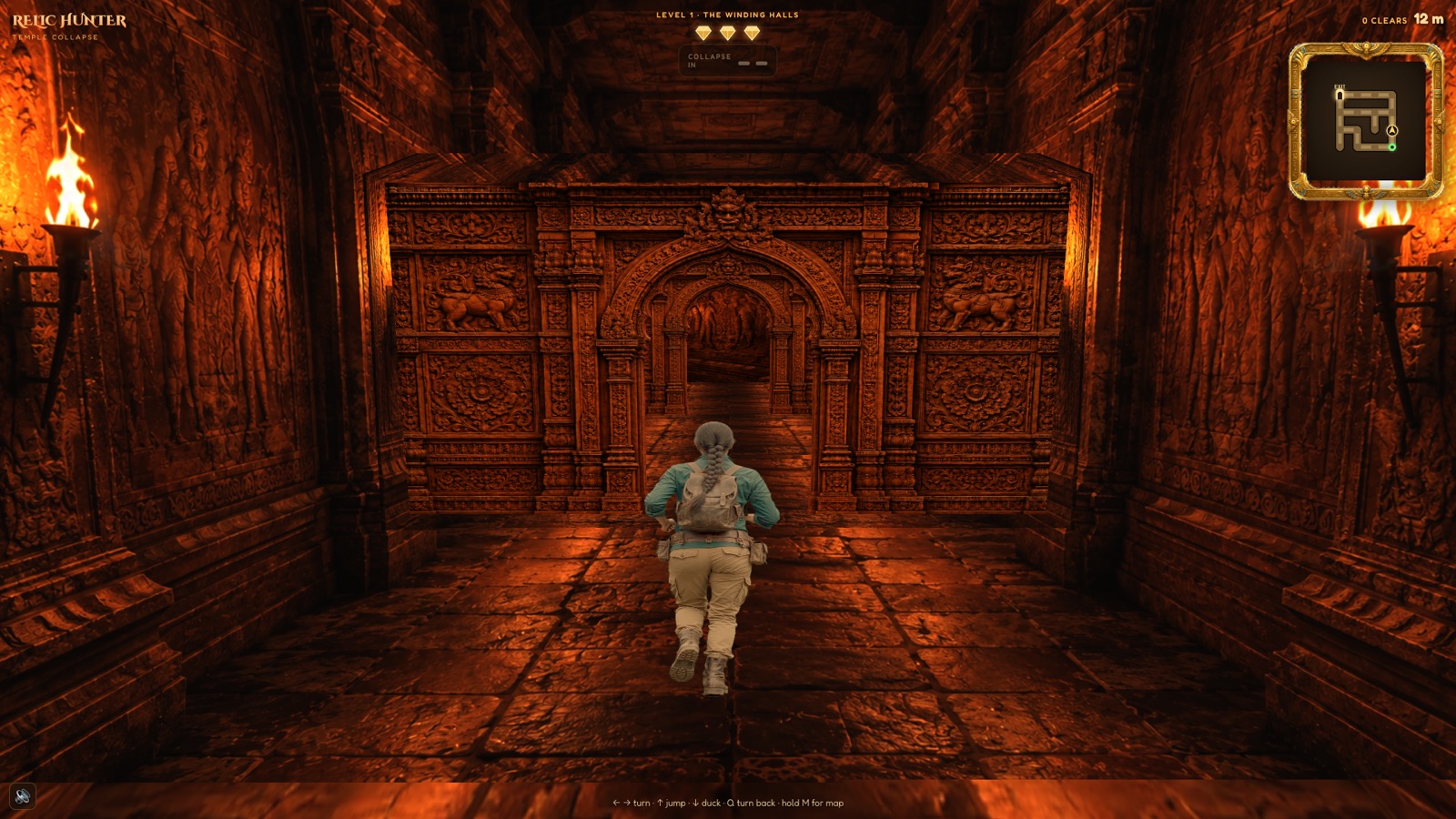
Relic Hunter: Temple Collapse sits between memory games and a fast maze game. It asks you to study a map, hold a route in mind, make decisions at junctions and react to hazards while a timer keeps moving. For players searching for browser games for memory and focus, the important point is that its challenge is not random: each mechanic asks the player to use a specific skill.
That makes Relic Hunter the right sort of cognitive game for a short browser session: active rather than passive, easy to understand, difficult to execute cleanly and naturally replayable. It is not a medical treatment and we do not claim that playing it will raise intelligence or prevent cognitive decline. The more accurate claim is useful on its own: the game repeatedly exercises spatial memory, attention, route planning and response selection while you play.
How memory games and maze games overlap
Before every trial, Relic Hunter shows the maze from above. Then the run begins and the viewpoint drops into the corridor. The player has to translate a bird's-eye map into a sequence of first-person decisions: left here, right at the next junction, straight past the opening, then turn toward the exit.
That is a form of spatial wayfinding. You are connecting an abstract map to a moving view of the environment and maintaining a sense of where you are inside it. Navigation research describes this internal representation as a cognitive map. Studies using virtual navigation tasks likewise ask players to inspect a map and then find goals from memory, making the relationship between map reading, route recall and spatial performance explicit.
One controlled study of a purpose-built VR wayfinding game found gains in a measure of high-fidelity long-term memory after repeated training in healthy older adults. The researchers also stress that results across game-based interventions are mixed and depend on the task. Relic Hunter has not itself been tested as a cognitive intervention, but its core loop uses the same broad ingredients: novel layouts, route learning and repeated wayfinding. Read the Scientific Reports study on virtual wayfinding and memory.
2. It uses working memory without turning play into homework
A route is useful only if you can keep it available long enough to act on it. During a run, the player holds a short plan in mind while new information arrives: a blade swings, a fire jet activates or a dead end proves that one instruction was remembered incorrectly.
This is where the design earns its pressure. The map can be checked again by holding M, so the task is not a pure memory test. But looking has a cost because the timer continues. The player decides whether to trust the current plan or spend time refreshing it. That small trade-off turns recall into a gameplay decision.
3. It combines attention with response selection
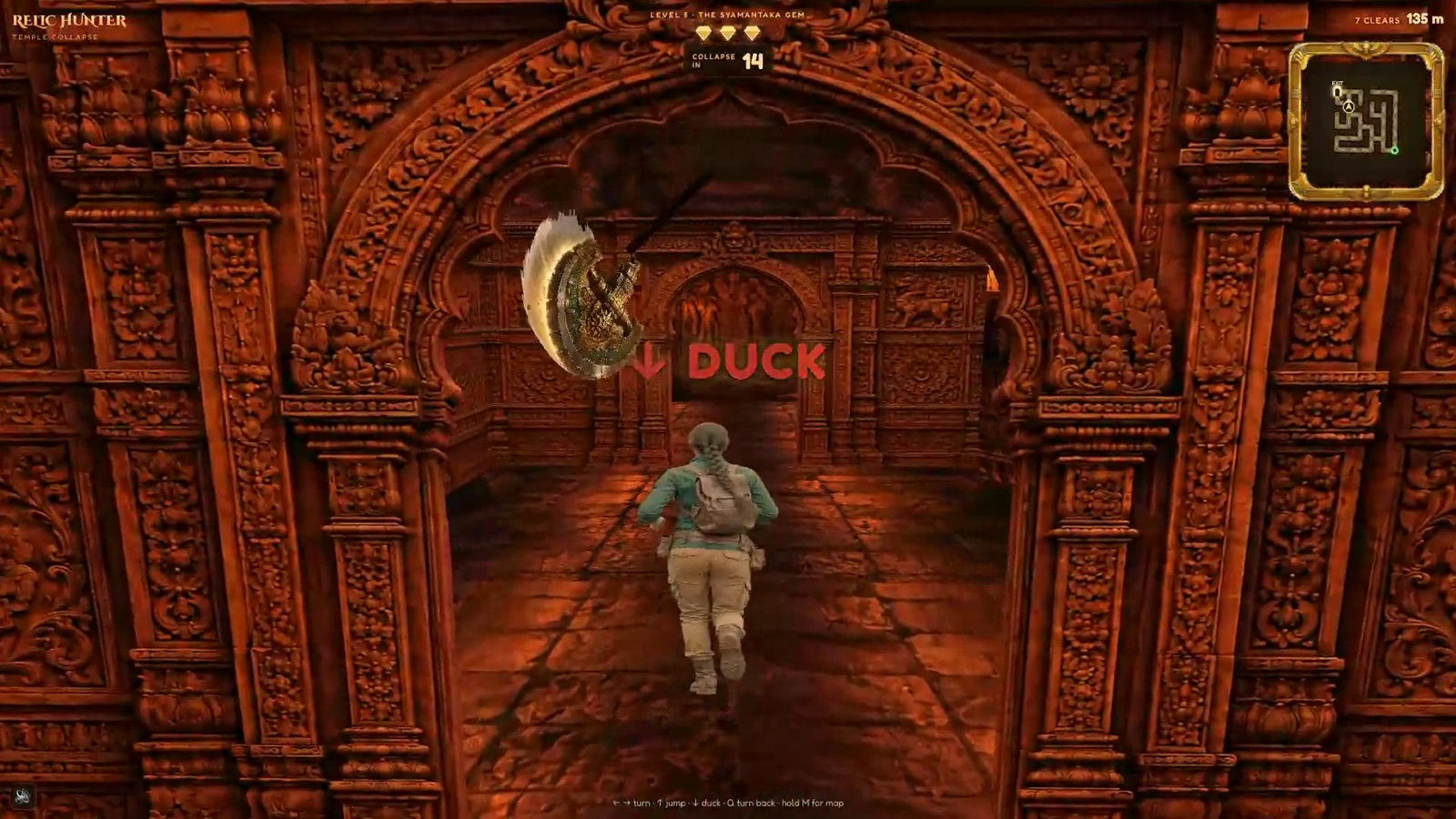
The temple contains different hazards with different answers. A high blade calls for a duck. A beam or floor gap calls for a jump. A junction calls for a directional choice. The player must notice the cue, identify what it means and select the correct input before reaching it.
Crucially, the game teaches these responses progressively. Early trials introduce the vocabulary of the temple before later trials combine it. Difficulty comes from coordinating known actions under time pressure, not from hiding the rules.
Research on video-game play has examined effects across executive function, motor skill, spatial imagery and visual processing, but it also distinguishes correlations in experienced players from improvements caused by training. That distinction is why we describe Relic Hunter as exercising these processes during play rather than promising broad transfer to everyday cognition. See the meta-analysis of video games and information processing.
4. It rewards planning, then asks you to adapt
The ideal run starts before the character moves. You scan the map, break the route into landmarks and decide where the difficult turns will be. Once inside, execution may expose a mistake. The useful response is not frantic input; it is reorientation. Turn around, recover the last reliable junction and update the plan.
This plan–act–check–adjust loop is what gives the maze meaning. A single wrong turn provides immediate, understandable feedback. On the next life, the player is not merely trying harder; they are carrying a revised model of the route.
5. Short runs make deliberate replay feel natural
Cognitive challenge works best when the player wants another attempt. Relic Hunter's trials are short, the goal is clear and failure usually has an identifiable cause. You remember the junction you misread or the blade you tried to jump instead of duck. That makes the next run purposeful.
Stars and best times give successful players a reason to return as well. The first objective is survival. The next is a cleaner route, fewer map checks and a faster exit. The maze stays the same long enough to be learned, while the player's performance changes.
Why it works as a memory game for adults
Relic Hunter fits a useful middle ground. It is more mentally active than an idle game, but it does not ask for a long tutorial or a multi-hour commitment. It creates pressure, but each run is brief. It rewards memory, but lets the player reopen the map. It demands quick reactions, but teaches every action before combining them.
Many searches for memory games for adults lead to matching cards or formal brain-training tasks. Relic Hunter offers a different kind of challenge: memory is embedded in an adventure with a goal, atmosphere and consequences. The player is not memorising symbols for their own sake; they are remembering a route because a wrong turn brings the temple closer to collapse.
It is also one of the memory games online that can be started without an account or installation. Desktop players can use the arrow keys or WASD; mobile players can swipe and tap. That low-friction format makes a short attempt, and a deliberate replay, easy.
What Relic Hunter exercises while you play
- Spatial memory: remembering the layout and your position inside it.
- Route planning: turning a map into a sequence of decisions.
- Focused attention: spotting the next hazard or junction while ignoring visual noise.
- Response selection: choosing jump, duck or turn from the cue ahead.
- Error correction: recognizing a wrong route, reorienting and updating the plan.
- Speed–accuracy judgment: deciding when to trust memory and when to check the map.
Those skills are built into the action rather than added as a lesson around it. That is the real value of the design: the player comes for the sun-gem and the collapsing temple, while the thinking happens naturally inside the run.
Put your route memory to the test
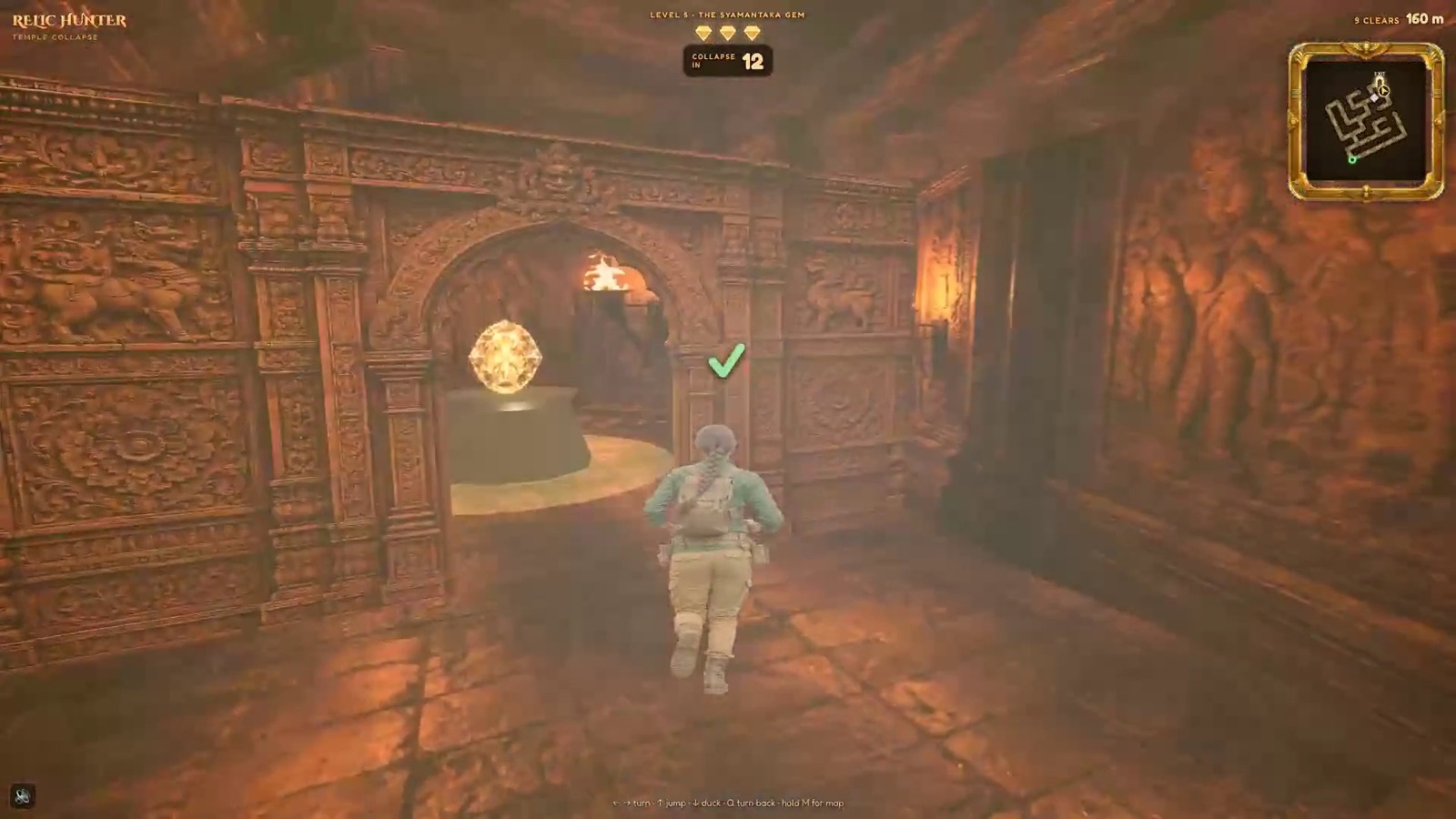
Play Relic Hunter: Temple Collapse in your browser. Study the maze, choose Mira or Vikram, and see whether you can bring the Syamantaka Gem back into daylight.
Free to play · No download · Keyboard and touchscreen controls · Six maze trials.
Read how Relic Hunter was built with AI images and Three.js · Browse more browser games.