Logic Puzzle Games: 7 Ways to Solve Yantra's Machines
I built Yantra around one button that players often press too late.
The button says Start. It does not lock an answer or spend a life. It simply releases the steel balls and shows what the machine does. Still, it is tempting to keep adjusting ramps until the route looks perfect.
The fastest way through Yantra is to treat every run as evidence. These seven habits make its logic puzzle games easier to read without turning them into guesswork.
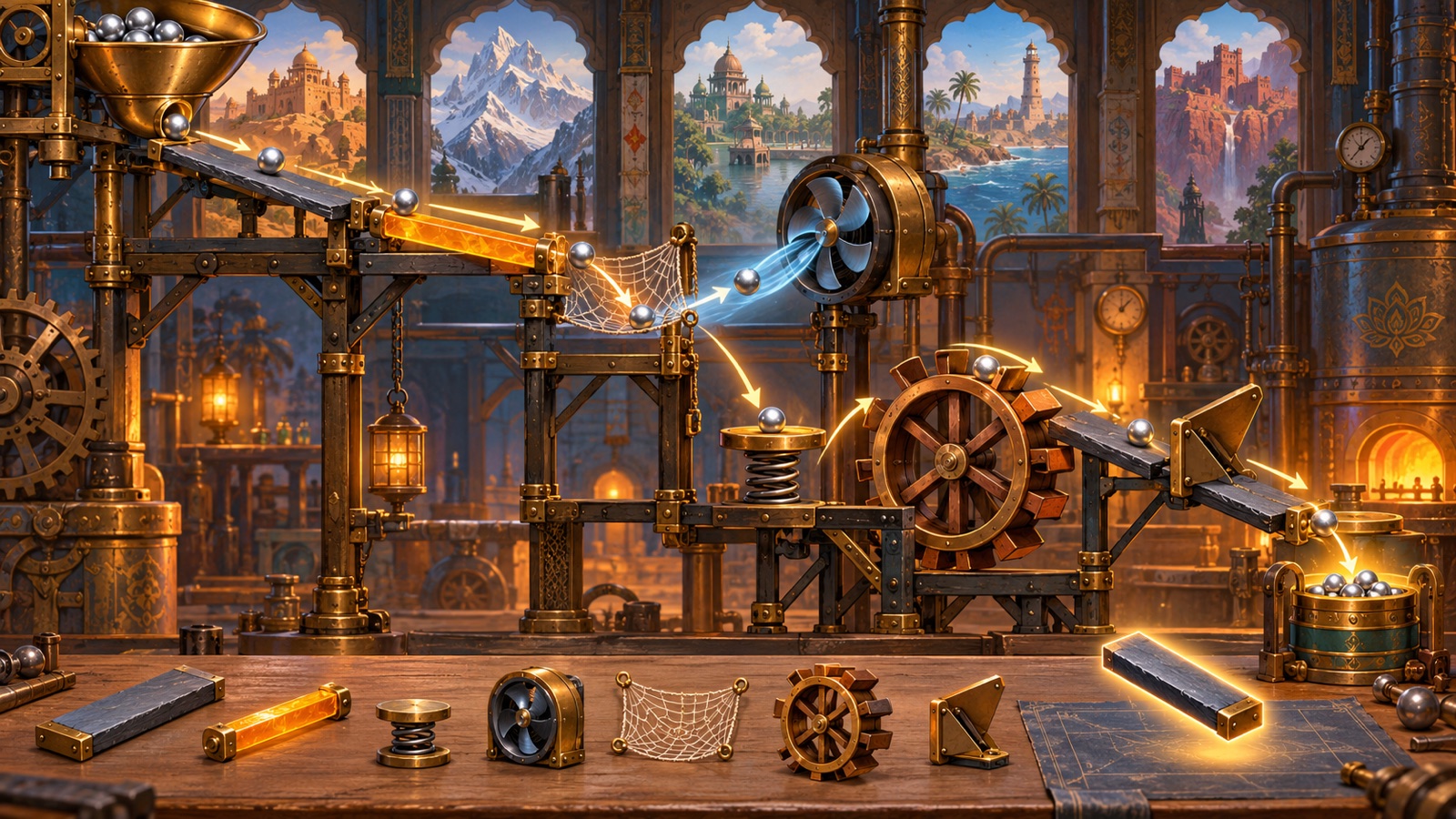
1. Read backward from the receiving machine
The hopper shows where the balls begin, but the goal often gives the clearer clue. Look at the final gap before the receiving machine. Ask what direction, height and speed a ball needs at that point.
Then trace the route backward. A high goal may need a spring or a final descending ramp. A narrow entrance may require a slower delivery. This reduces a large machine to one immediate connection.
Once the last link makes sense, follow the chain toward the hopper until you find the first missing idea.
2. Press Start before moving everything
Most levels begin as broken machines, not empty boards. Much of the route already works. Run it once and watch the first ball.
Do not count every spill yet. Find the earliest moment when the ball stops following a useful path. It might leave a ramp at the wrong angle, lose momentum before a climb or strike the front of a one-way flap.
That first failure is the next problem. Anything after it is only a consequence.

3. Change one variable per run
Moving three parts before the next test creates a new machine, but it does not teach you which change helped.
Move one ramp. Rotate one spring. Reverse one flap. Then press Start again. If the failure moves farther along the path, keep the change and work on the new problem. If it becomes worse, undo it.
This habit makes a complicated puzzle strategy game feel smaller. Each run answers one question instead of judging the whole design.
4. Choose a material for its behaviour
Yantra's parts are not different skins for the same platform.
- Slate and amber bars create direct surfaces. Angle controls where the ball leaves them.
- Silk nets catch, sag and release, which can soften a fast arrival.
- Gust fans carry a ball through a directional zone without needing a solid floor.
- Spring pads turn a fall into a launch. Rotation aims the next arc.
- Paddle wheels respond to contact, so timing and momentum matter.
- One-way flaps block from one side and allow passage from the other.
Start with the movement you need, then choose the part. A spring is useful for height, but it is a poor substitute for a gentle bridge.
5. Use the ball trail, not the part outline
A ramp can look perfectly aligned while the ball still leaves its edge too quickly. The useful line is the actual ball path.
Watch where the centre of the ball travels and where it makes contact. A small rotation can change both launch direction and speed. If a ball clips the corner of the next part, adjust the previous part rather than dragging the target toward every near miss.
For fans and springs, the entry matters as much as the exit. A good part placed under the wrong approach will still produce a bad route.
6. Clear first, then remove spills
A working route and a clean route are separate achievements. Delivering the quota clears the level. Fewer spills improve the star result, and a spill-free run can reach three stars.
On the first pass, accept a rough solution that proves the idea. Then study where the extra balls escape. A wider catch, calmer entry or smaller angle change can make the same route reliable.
This is usually easier than demanding perfection from an untested design. First answer whether the machine can work. Then answer whether it can work repeatedly.
7. Use hints to recover the next idea
A hint highlights a useful placement. It does not complete the run or explain every later interaction.
Before using one, state the problem in plain language: the ball is too low, too fast, moving the wrong way or arriving on the wrong side. Then compare the highlighted part with that description.
Move the part yourself and watch the next run. The hint is most useful when it restores the missing idea instead of becoming a position to copy.
A quick solving checklist
- What does the ball need immediately before the goal?
- Where does the first useful path actually fail?
- Did I change only one variable?
- Does this material create the movement I need?
- Am I watching the ball path instead of the art?
- Have I separated clearing the level from earning three stars?
- Can I explain why the hint placement works?
Repair the first machine
Yantra becomes readable when every run has a question. The machine moves, the ball answers and the next change becomes smaller.
Play Yantra: Contraption Puzzle free in your browser. Run the first broken machine before moving its loose ramp, then repair the earliest failure you can see.
Free to play · No download · Mouse or touch · 70 levels · Eight material behaviours · Daily puzzles.
For the design story, read how I built 70 broken machines across five worlds. If you prefer structural puzzles, try the seven-step guide to stronger bridges in Puliya.