Maze Games: 7 Rules for Escaping Relic Hunter
I wanted Relic Hunter to make the maze feel urgent without making it random. The temple is collapsing, but the route can still be read. A wrong turn should cost time because the player misread the map, not because the game quietly changed the answer.
That decision shaped all six trials. The map and the 3D corridors come from the same maze data. Every passage shown on the minimap is a real passage. Every dead end can be escaped. The challenge is learning to read the route while the timer, hazards and camera keep moving.
If you are looking for maze games with a practical strategy rather than a hidden walkthrough, these are the seven rules I use when I play Relic Hunter.
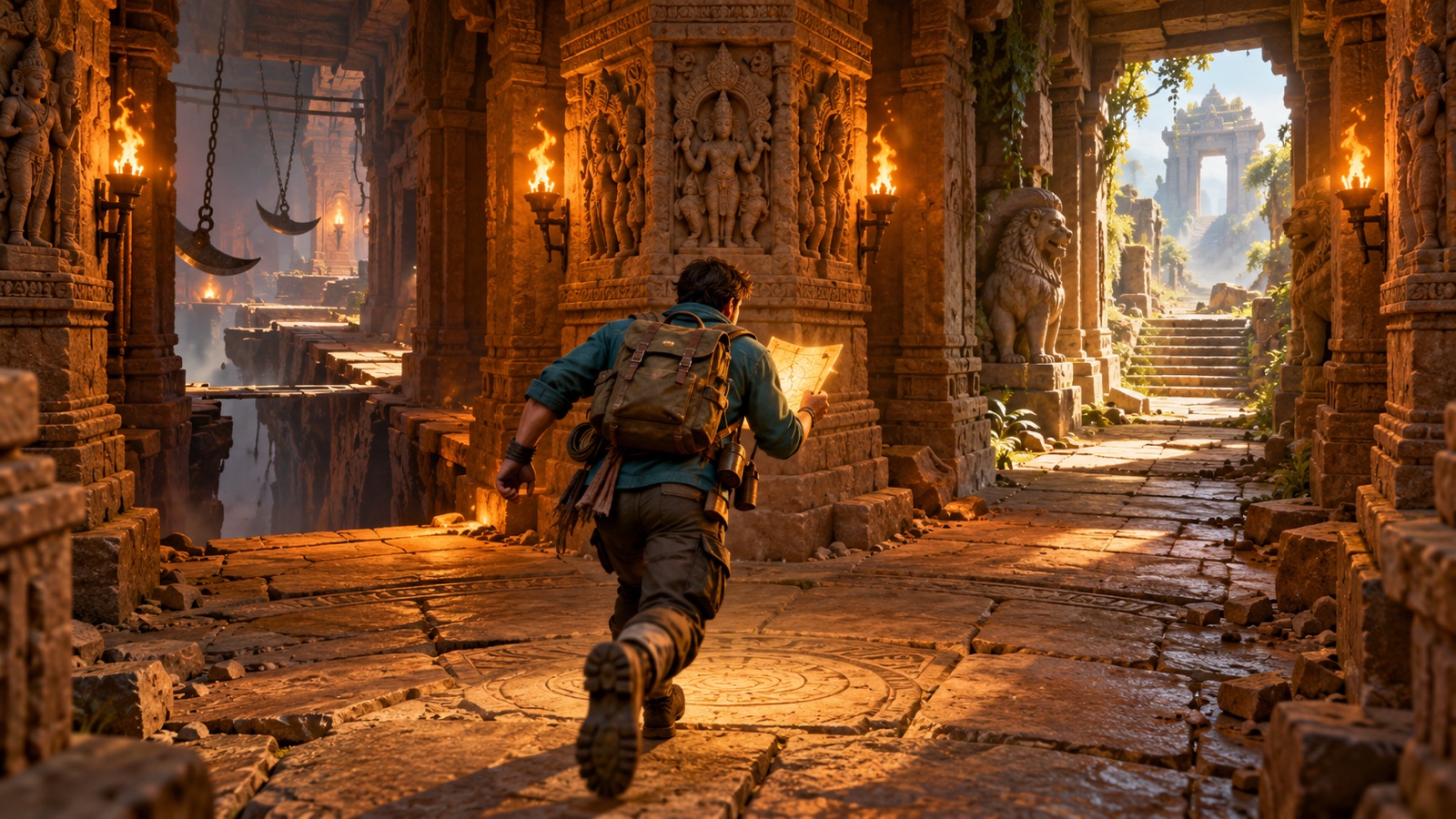
1. Read the map before the countdown becomes pressure
Each trial gives you a short reading window before the run becomes urgent. Use it. Find the start marker, the exit and the first two meaningful turns.
I do not try to memorise the entire maze. I divide it into a few decisions: first turn, middle landmark and final approach. That is enough to begin with a plan without freezing at the start.
The Winding Halls is built for this habit. It has seven junctions and no hazards. The first trial is not testing your jump timing. It is teaching you that navigation is the main problem.
2. Read the minimap relative to the runner
The minimap rotates so the direction you are travelling stays readable. That means the useful question is not “where is north?” It is “which opening is on my left or right now?”
Watch the runner marker as you approach a junction. Match the visible corridor to the opening on the map, then commit. Waiting until the character reaches the wall wastes the widest part of the turning window.
This matters more in later 3D maze games because a richly detailed corridor can make two junctions feel similar. The map gives you the structural information that the stone walls cannot.
3. Use one landmark to confirm each section
A route becomes easier to remember when one visible event confirms that you are still on it. A long straight hall, a left turn followed by a blade, a cracked floor before a right turn or the bright exit corridor can all work as landmarks.
Do not remember a list of twelve instructions. Remember short pairs. Left, then beam. Right, then crack. Straight until fire. These pairs join the route to something you can see and act on.
The trials add hazards in a deliberate order. Whispering Blades introduces fallen beams and swinging blades. The Sunken Deep adds cracked floors. The Lion's Maw adds fire. The new obstacle becomes a useful route marker as well as a threat.
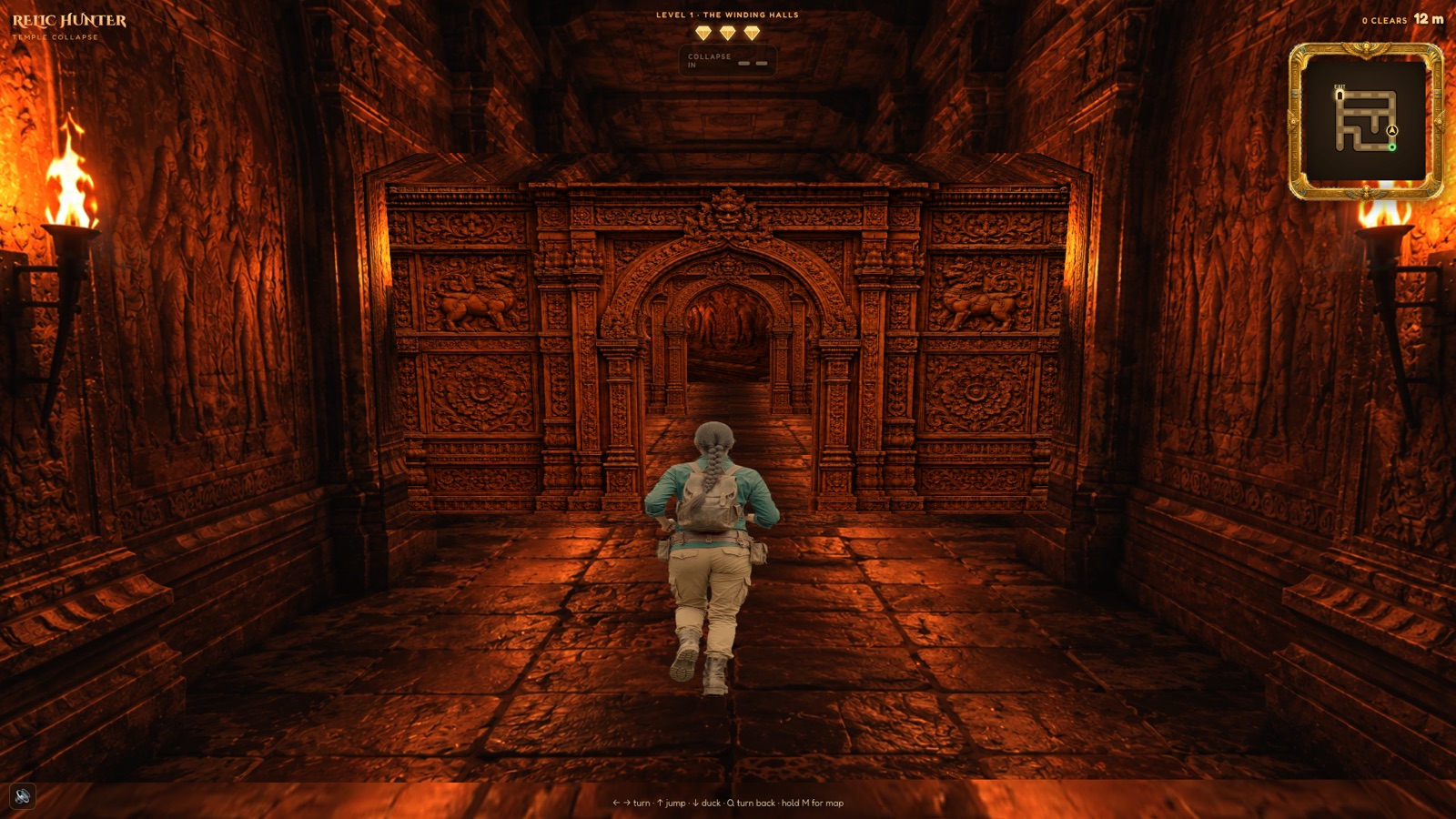
4. Treat a dead end as a navigation state, not a lost life
A dead end is expensive, but it is recoverable. The runner stops at the wall. Turn around, find the junction you just passed and choose the unused branch.
The worst response is to press several directions in panic. One deliberate turn preserves your sense of orientation. Random inputs make it harder to recognise the corridor when you return to the junction.
In a timed maze escape game, recovery speed matters. But controlled recovery is still faster than becoming disoriented twice.
5. Separate navigation decisions from hazard actions
Turning, jumping and ducking are different decisions. I handle them in that order.
At a junction, choose the route first. In a corridor, watch the next hazard. Fallen beams, cracked floors and low fire require a jump. Swinging blades and high fire require a duck. Once the action is clear, use one clean input.
Trying to solve the map and the obstacle at the same instant creates avoidable mistakes. The game telegraphs both, but attention still has limits. Look ahead far enough that the decisions do not pile up.
6. Protect the three shared lives
The six trials share one pool of three lives. A careless mistake in an early level leaves less room for the faster final escape.
I value consistency over a dramatic shortcut. If I am unsure at a junction, I check the map. If a hazard cue is visible, I make the safe movement instead of squeezing one more second from the run.
The star system rewards time left on the clock, but a completed trial always matters more than a fast failure. One star means you escaped. Two and three stars are reasons to return after the route is familiar.
7. Learn the campaign as three different problems
The six levels look like one chase, but I think of them in three groups.
- Learn the route: The Winding Halls teaches map reading without hazards.
- Combine route and movement: Whispering Blades, The Sunken Deep and The Lion's Maw add beams, blades, cracks and fire while the route grows longer.
- Finish the story: The Syamantaka Gem asks you to reach the artifact. Into Daylight raises the running speed and reduces the reading time for the final escape.
This grouping keeps a failed run useful. Instead of saying “I am bad at the whole game,” I can identify the actual problem. Did I misread the map, mistime a hazard or lose too many lives before the last two trials?
A quick Relic Hunter checklist
- Find the exit and first two turns before running.
- Read left and right relative to the runner marker.
- Attach each route section to one visible landmark.
- At a dead end, turn once and return to the last junction.
- Choose the route before reacting to the next hazard.
- Protect lives early, then chase faster star times later.
- Treat each failure as one specific navigation or timing problem.
Take the Syamantaka Gem and find daylight
The best maze game strategies do not remove uncertainty. They give you a repeatable way to handle it. Read ahead, make one decision at a time and use each failed route to improve the next run.
Play Relic Hunter: Temple Collapse free in your browser. Choose Mira or Vikram, clear all six trials and escape with the Syamantaka Gem.
Free to play · No download · Keyboard, touch or webcam controls · Six timed maze trials.
For the production story, read how I built Relic Hunter with Three.js and AI images. For the cognitive angle, read how route recall, attention and planning appear inside the game.