Mythology Games: Why Relic Hunter Uses the Syamantaka Gem
I had a temple, a runner and a collapse timer. What I did not have was a reason to enter.
“Reach the exit” worked as a rule, but it did not work as a story. The player needed to want something inside the maze, and taking it needed to change the final escape. That is why Relic Hunter uses the Syamantaka Gem.
The game treats it as Surya's sun-jewel. It does not try to retell the full traditional story. It borrows one clear image, a radiant jewel connected with the sun, then builds a fictional temple adventure around the consequence of lifting it.
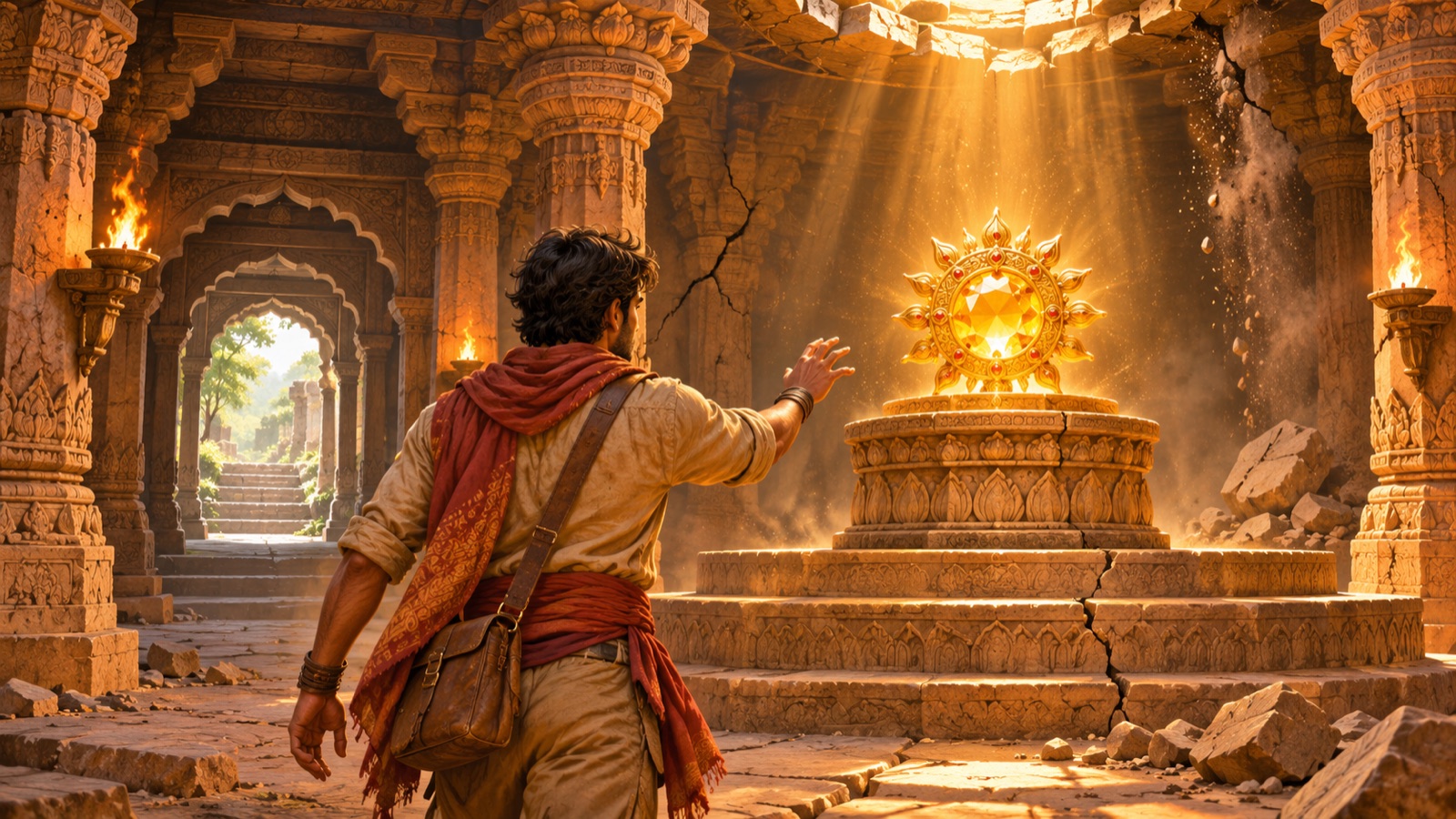
A mythological object solved a game-design problem
Many mythology games begin with a large cast of gods, monsters and histories. Relic Hunter begins smaller. It needs one object that can be recognised at a glance inside a fast browser game.
A sun-jewel gave me the right visual language. It could glow in a dark chamber, cast warm light on the stone and remain readable from the running camera. It also felt important before the interface explained anything.
That let the story stay inside the action. The player sees the gold light, reaches the pedestal and understands that this is the object the campaign has been building toward.
The campaign delays the gem until trial five
Relic Hunter has six trials. The Winding Halls teaches map reading. Whispering Blades adds hazards. The Sunken Deep introduces cracked floors. The Lion's Maw adds fire. Only then does the player enter The Syamantaka Gem.
That order matters. If the gem appeared in the first corridor, it would be decoration. By trial five, the player has learned the temple's vocabulary and paid for progress with several successful escapes.
The gem becomes the campaign's answer to a simple question: what have these four trials been preparing me to reach?
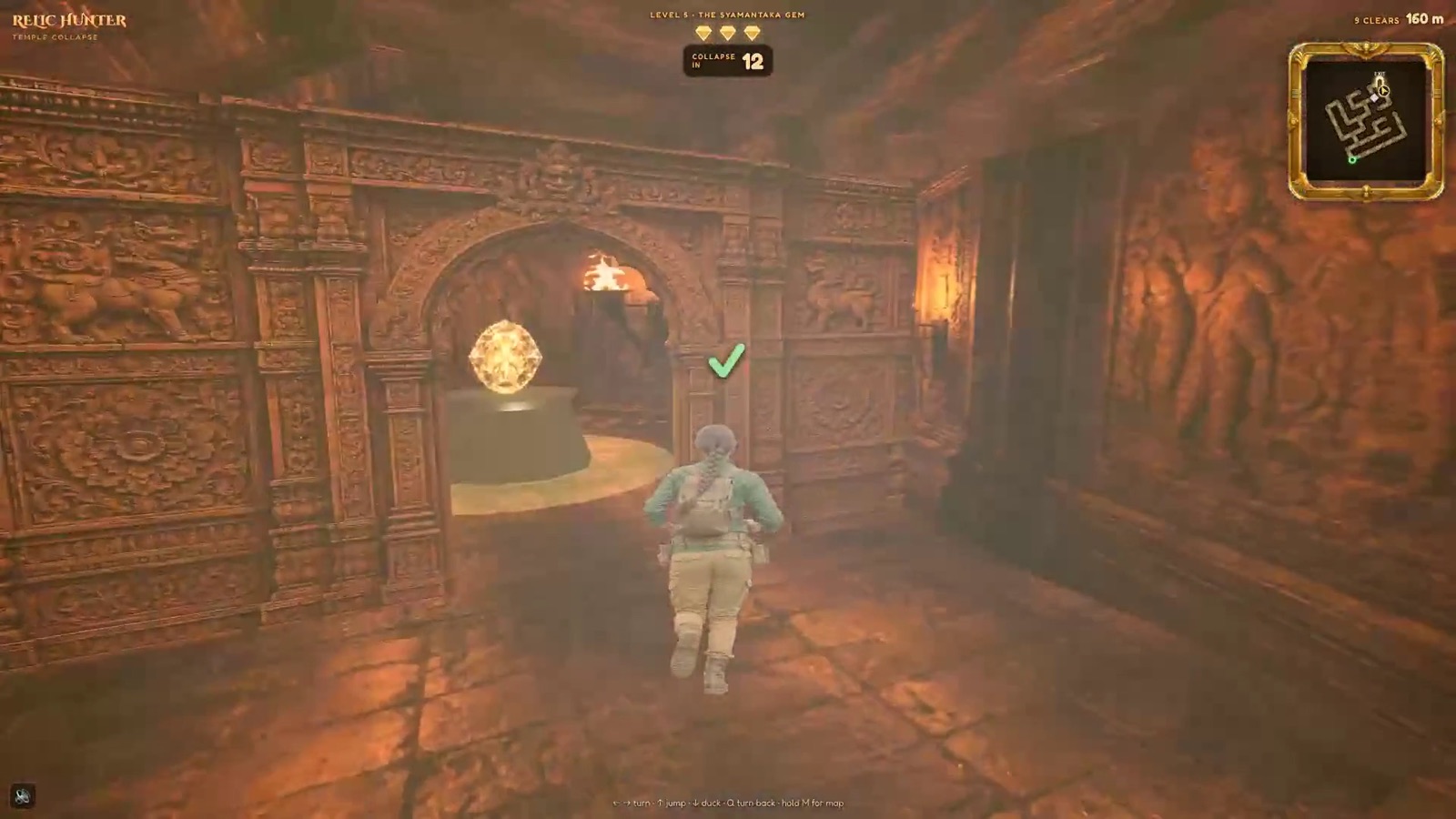
I made the jewel readable before making it realistic
My first gem was a small low-poly shape. It was technically three-dimensional and visually weak. Against carved stone and torchlight, it read as a flat gold mark.
The current prop uses a camera-facing image of the jewel with additive light. It floats slightly above the pedestal, pulses gently and throws a warm pool across the chamber. The geometry is less important than the silhouette and light.
That choice matches the rest of Relic Hunter. The temple uses projected images and billboard characters to make a cinematic scene load quickly in a browser. The gem follows the same rule: spend detail where the player will notice it.
Taking it changes the state of the world
The pickup is not a score icon. Mira or Vikram reaches the pedestal and raises the gem. The jewel brightens, the chamber reacts and a stone slab closes behind the hunter.
The code stores one session flag when the gem is taken. Trial six reads that flag and gives the runner a carried golden glow. The object is no longer on a pedestal, but its light stays with the player on the way out.
This is the story beat I cared about most. The final escape should not feel like another level selected from a menu. The player caused it by taking something.
The last trial is called Into Daylight
After the gem chamber, the campaign does not end with a victory card. It asks for one more run.
Into Daylight turns the reward into responsibility. You have the jewel, the temple is coming down and the visible goal is no longer treasure. It is the bright opening at the end of the route.
That structure gave the six levels a useful shape: enter, learn, descend, survive, take, escape. The Syamantaka Gem sits at the turn between the last two verbs.
Why I kept the mythology reference narrow
Relic Hunter is a fictional adventure, not a lesson on scripture and not a claim to reproduce a sacred place. Mira and Vikram are original game characters. The temple trials, traps and collapse are invented for play.
I kept the reference narrow because a recognisable name should not become an excuse to mix unrelated symbols into one fantasy backdrop. The game calls the object the Syamantaka Gem and connects it with Surya. The rest of the campaign is presented as Relic Hunter's own story.
That is also why the hero art focuses on a human decision at a pedestal rather than depicting a deity. The important moment in this Indian mythology game is the player's choice to take the jewel and find a way back out.
Lore should change what the player does
The lesson for me was simple. Lore works best when it is not stored only in a paragraph.
- The sun-jewel produces the strongest light in the darkest chamber.
- The fifth trial ends with a dedicated lift animation.
- The chamber closes after the pickup.
- The sixth trial carries the golden glow forward.
- The campaign ends only after the player reaches daylight.
Those are small systems, but together they let the object leave a mark on play.
Try the six-trial escape
You can play Relic Hunter: Temple Collapse free in your browser. Choose Mira or Vikram, clear the first four trials, take the Syamantaka Gem and carry its light into the final escape.
For practical help, read my seven maze escape rules. For the production story, read how I built Relic Hunter with Three.js and AI images.