Wildlife Games: How I Made Dart Ranger Tense Without Harm
I wanted to build a long-shot game without making the animal the enemy.
That decision sounds like a change to the story. It was actually a change to the whole game. If every animal must stay safe, I cannot use damage, injury or a dramatic takedown to make a hit feel important. I need tension before the shot, a clear result after it and a reason to care about every attempt.
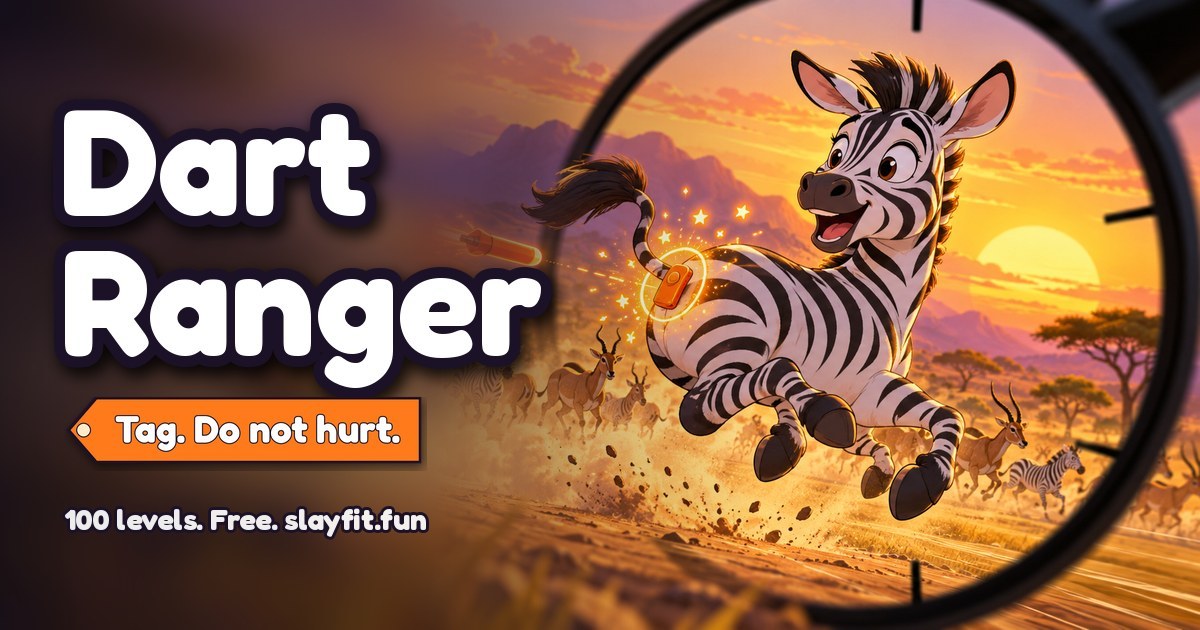
Dart Ranger became my answer. The launcher is toy-like. Its bright orange darts place tracker tags or gently put an animal to sleep. A tagged animal joins the player's sanctuary. Nobody is hurt, even when the player misses.

The first rule was that every animal stays safe
I wrote the constraint into the game specification before building the worlds: no blood, no harm and no failure animation that looks like harm. The phrase behind it was simple. All lives are precious.
That rule removed several familiar shortcuts. A hit could not end with an animal falling. A miss could not punish the animal. The launcher could not look or sound like a real firearm. Even the language had to stay clear about tagging and sleeping rather than defeating or killing.
Constraints like this are useful because they force the rest of the design to do more work. Dart Ranger cannot borrow tension from cruelty. It has to earn tension from observation, timing and limited chances.
I moved the pressure to the moment before the shot
The interesting question is not what happens to the animal. It is whether the player has read the situation correctly.
Long shots drop. Wind can lift or press a dart. Birds cross the lake. Otters and beavers move along the water. Fog hides part of the scene. A moving jeep adds its speed to the launch. Later worlds use cover, river bends, ice gates and shallow skip shots.
These systems create a pause before clicking. The player checks the wind, watches a movement pattern and decides where the animal will be when the dart arrives. That is where the suspense lives.
This is also why I kept the scope readable. A complicated interface would compete with the environment. The lake, the animal and the wind card should supply the information.
A miss costs opportunity, not a life
Removing harm does not mean removing consequences. Each level has a limited number of darts. Misses also reduce a calm meter. If calm runs out, the animals leave and the player tries again.
I like that failure because it fits the role. A careless ranger does not injure an animal. They lose the chance to tag it.
The numbers tighten as the campaign progresses. Early normal levels usually give two spare darts. Later sets and boss levels give one. Three stars normally require a clean run, and difficult levels ask the player to tag several animals with little room for guessing.
The bridge between kindness and difficulty is restraint. One deliberate correction is valuable. Firing repeatedly is expensive.
The difficulty comes from measurable shot windows
I did not want the later levels to become harder because the game quietly cheated. The level generator and solver measure how forgiving every shot really is.
For a fixed aim, the tools calculate the lateral hit window at the animal and the time window for a moving target. They also record whether the shot needs wind, a bounce or a skip. A verification run replays stored solutions through the same simulation used by the game.
The balance pass uses those measurements to tighten the campaign without making it a guessing game. A casual aim model adds small errors in angle, timing and wind reading. If a level becomes implausibly strict, the generator widens its window. Upgrades can help by roughly 10 to 20 percent, but the level must still work without them.
This mattered to the tone. A kind game can still demand accuracy. It just needs to be honest about the accuracy it demands.
Wildlife variety changes the problem, not the value of a hit
The campaign spans five worlds and 100 levels. Pine Lake starts with open shots, wind, birds and animals moving on the water. Geyser Valley uses cover and brief sightings. Savanna Safari adds a moving jeep and herds. Amazon River Run combines boats, canopy and water. Arctic Run uses floes, squalls and gates in the ice.
Species are not only visual rewards. A flying duck creates a different timing problem from a heron on the bank. A swimming otter follows the surface. A marked animal inside a herd asks the player to identify before firing.
I also corrected the roster when the setting was wrong. The penguin was removed from Arctic Run because penguins do not live in the Arctic. A muskox calf took its place. That small fix reflects the broader point: if I am making a wildlife game, the wildlife should not be interchangeable decoration.
The sanctuary changes what success means
Every tagged animal moves into a sanctuary collection that grows as the player completes levels. The hit is not the end of the relationship. It adds a healthy animal to a place the player can revisit.
This is the part that separates Dart Ranger from a reskinned shooting game. The sanctuary gives the tracking mission a destination. Stars and coins still provide progression, but the collection explains why the ranger is taking careful shots in the first place.
I am careful not to present this as a real conservation simulator. Dart Ranger is a browser game, not a model of field biology. The sanctuary is a design device that aligns the reward with protection rather than domination.
Non-violent games still need sharp feedback
Kindness cannot be an excuse for vague feedback. The player needs to know whether a dart passed high, fell low, arrived late or hit cover.
The orange tag, a clear sound and the sleeping pose make a successful shot readable without pain. A miss notice helps the player adjust the next attempt. Wind streaks, scope movement and visible animal motion explain what changed before the shot.
That feedback keeps the loop practical: observe, decide, fire, read the result and correct. The emotional tone is gentle, but the interaction remains precise.
What I learned from designing around one hard boundary
The no-harm rule did not make Dart Ranger smaller. It gave me a clearer place to build.
I replaced damage with limited opportunity. I replaced a violent payoff with a readable tag and a growing sanctuary. I moved suspense into wind, movement, distance and timing. Then I used simulation, solvers and player models to make sure those systems created real difficulty rather than arbitrary misses.
That is the useful lesson for me. A boundary can remove the easiest answer and reveal a more interesting one.
Start the ranger mission at Pine Lake
Play Dart Ranger free in your browser. Read the wind, tag the animals safely and grow the sanctuary across five worlds.
For practical shot advice, read my seven-step Dart Ranger guide. For another game built around careful feedback instead of punishment, read how I designed Puliya's first lessons.